
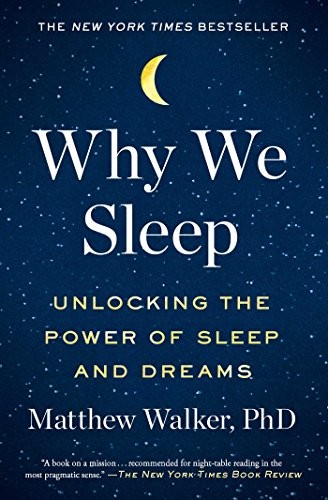
There is a promise that almost all of us have made at some point: sleep less during the week and "catch up" on Saturday. Matthew Walker, a sleep scientist, dismantles that promise with data: the brain does not allow you to repay that debt, and every lost hour leaves a measurable trace in memory, the immune system and mood. What follows is the biological architecture that explains why.
Walker builds this analysis from the neuroscience of sleep, deliberately moving away from the productivity discourse to treat sleep as a mandatory, non-negotiable biological function — with measurable consequences when ignored.
If you remember only one idea
Sleep is not downtime: it is the process by which the brain cleans itself, repairs memory and regulates emotions — and nothing you do afterward can compensate for sleep already lost.
- Sleep is a mandatory biological function, not a cuttable luxury.
- Two independent systems — Process C and Process S — determine when and how you sleep.
- Lost sleep is never recovered: there is no way to repay the debt afterward.
Audiovisual analysis
Audiovisual summary and podcast on the book’s central ideas.
Before we begin
The concepts underpinning the analysis
Before entering the mechanism, it is worth fixing the minimum vocabulary Walker uses to explain why sleep works the way it does and why it admits no shortcuts.
The bi-factorial model (Process C + Process S)
What it means: two independent biological systems — a 24-hour clock and an accumulated chemical pressure — that together decide when you feel sleepy.
Why it matters: it is the foundation of the entire book; ignoring either of the two processes guarantees lower-quality sleep, even if you sleep enough hours.
Suprachiasmatic Nucleus (SCN)
What it means: a cluster of neurons in the brain that acts as a master clock, marking the 24-hour cycle of alertness and sleep.
Why it matters: it explains why your body "knows" the time even without a clock or external light.
Adenosine
What it means: a substance that accumulates in the brain the longer you stay awake, building sleep pressure.
Why it matters: it is what caffeine artificially blocks — without eliminating the real fatigue.
NREM-REM cycles
What it means: roughly 90-minute blocks alternating deep sleep (NREM) and dreaming sleep (REM) throughout the night.
Why it matters: each phase serves a distinct function; cutting the night short cuts specific functions, not merely hours.
Glymphatic system
What it means: a brain-cleaning mechanism that activates during deep sleep to eliminate metabolic waste.
Why it matters: without sufficient sleep, that waste — including proteins associated with cognitive decline — accumulates.
Genetic chronotype
What it means: each person's natural tendency to be more of a morning or evening type, determined in large part by genetics.
Why it matters: forcing schedules contrary to one's own chronotype desynchronizes the system even if you sleep the necessary hours.
Zeitgebers (light and temperature)
What it means: external signals — primarily light and temperature — that synchronize the biological clock with the outside world.
Why it matters: they are the most direct lever you have for adjusting the system from outside.
The book's journey
Problem
Normalized sleep deprivation as discipline
Common error
Believing that lost sleep can be recovered by sleeping in on the weekend
Thesis
Lost sleep is never recovered
Framework
Process C + Process S aligned
Application
8-hour window, consistent schedules, thermal and light hygiene
Result
Cognitive, immunological and emotional homeostasis
01 — Central thesis
The debt that cannot be repaid
Most people treat sleep as the most flexible item on their schedule: the first to be cut when the day gets complicated and the one "recovered" by sleeping in on the weekend. That logic of compensation works with money, but not with sleep.
Walker shows that the body does not keep a pending balance that can be settled later. Sleep deficit is what the book describes as an "all or nothing" event: the chemical purge and neuronal repair happen exclusively while you sleep — not at any other time, nor in a deferred manner. Sleeping more one day does not erase the deficit accumulated on previous days.
Central thesis
Sleep is not a passive state that can be cut or postponed: it is a mandatory biological function, perfected over millions of years of evolution, and lost sleep is never recovered.
The practical consequence is uncomfortable: every short night is not a one-time expense but a definitive loss. The book does not ask for alarm, it asks for precision about what is really at stake each time you decide to go to bed later than your body needs.
02 — The central mechanism
Two clocks, one alignment
To understand why sleep cannot be improvised or compensated, you must understand that it does not depend on a single mechanism, but on two independent systems that must coincide at the right moment.
Process C here means an internal clock of approximately 24 hours, directed by the Suprachiasmatic Nucleus, which generates a predictable wave of alertness throughout the day — independent of how much you have slept. Process S here means a chemical pressure that grows the longer you stay awake, accumulated by adenosine, and which only discharges through sleep.
When both processes are aligned — high circadian signal, low adenosine pressure — the body reaches its point of maximum alertness. When they are misaligned — for example by caffeine masking Process S or by schedules that contradict Process C — the feeling of alertness is no longer a reliable signal of the actual state of the organism.
03 — The system components
The four operational pillars
The bi-factorial system rests on four components that operate in a coordinated way. None replaces the others.
01
Process C
The circadian pacemaker that regulates temperature, metabolism and melatonin release in a ~24-hour cycle.
02
Process S
The sleep pressure accumulated by adenosine, which is only eliminated through sleep — never by any other means.
03
NREM-REM Architecture
90-minute cycles alternating memory cleanup and consolidation (NREM) with emotional integration (REM).
04
Thermal and light Zeitgebers
External light and temperature signals that synchronize the internal clock with the actual environment.
04 — The deep layer
What happens when no one is watching
Beneath the mechanics of the two processes lies a more uncomfortable implication: much of what sleep repairs is invisible while it happens, and only manifests as absence when it is missing.
1
Memory consolidation
During deep sleep, the brain transfers memories from the hippocampus — a fragile, short-term store — to the cortex, where they are better protected. Without this phase, what was learned during the day is less consolidated, even if the person does not notice it immediately.
2
Emotional recalibration
In REM sleep, the brain crosses recent information with personal biography — a process associated with creativity and emotional balance. Its absence leaves the day's experiences unprocessed, which translates into greater emotional reactivity the following day.
3
Glymphatic cleanup
The glymphatic system here means a brain drainage mechanism that multiplies its activity during deep sleep to eliminate metabolic waste, including beta-amyloid protein. It is the quietest layer of the system: you do not feel it working, but its prolonged absence has measurable cumulative consequences.
The long-term consequence is that the cost of poor sleep is not paid immediately, but in installments that accumulate without warning: less reliable memory, poorly regulated emotions and a brain that cleans less and less of what it produces.
05 — Friction zones
Where and why the system fails
The bi-factorial system is robust, but several everyday practices deactivate it without the person perceiving it as a failure.
Caffeine
Blocks adenosine receptors, masking sleep pressure without eliminating it. The real fatigue returns all at once when the effect wears off.
Alcohol and sedatives
Fragment sleep architecture and block the REM phase. They produce unconsciousness, not the biologically restorative sleep the system needs.
Social jet lag
Work schedules that force nocturnal chronotypes to function as morning types, chronically desynchronizing Process C.
Blue light at night
Short-wave light from screens suppresses melatonin and can delay the internal clock by several hours.
None of these practices produces an immediate collapse; that is why they are easy to ignore. Their effect is cumulative, and the book is honest on one point: once lost, that margin of sleep is not restored by goodwill or a single long night.
06 — Implementation protocol
How to activate the system
The book does not offer tricks, but rather conditions for the two processes to align each night.
01
Reserve an 8-hour window
The minimum estimated time to complete the adenosine purge and the cycles of memory and emotional consolidation.
02
Maintain consistent schedules
Go to bed and wake up at the same time, including weekends, so as not to break the anchor of Process C.
03
Reduce caffeine in the preceding hours
Avoid masking Process S just when the body needs to feel the accumulated sleep pressure.
04
Take care of thermal and light hygiene
Lowering the room temperature and reducing blue light before sleep facilitates the thermal drop that activates sleep.
05
Recognize your own chronotype
Design work and rest schedules that do not force the body to fight against its natural rhythm.
What to remember
- Lost sleep is never recovered; the brain does not allow the debt to be repaid afterward.
- Alertness depends on two independent systems — Process C and Process S — being aligned, not on willpower.
- Caffeine postpones fatigue; alcohol fragments sleep. Neither produces it.
- Each 90-minute cycle serves different functions: consolidating memory and regulating emotions.
- The cost of poor sleep is cumulative and invisible until the system begins to fail.
What this book does not say
It is not a manual of sleep hygiene tricks nor a list of nighttime habits without explanation. Nor is it a moralizing warning about laziness: the problem Walker describes is not one of discipline, but of a biological system that does not negotiate with the schedule. And it does not offer an infallible method of express recovery: its most uncomfortable point is precisely that, once lost, that sleep does not return.
Synthesis
A debt the body carries in silence
The bi-factorial system Walker describes is not only a biological explanation: it is a change of perspective on what "performing" means. If sleep is the only window in which the brain cleans, consolidates and recalibrates, then every cut is not time gained but capacity that will not return.
The question it leaves open does not have a comfortable answer, but it is the one that sustains the entire analysis.
If lost sleep is never recovered, how many important decisions in your life have you already made in a state of irreversible biological deficit?