
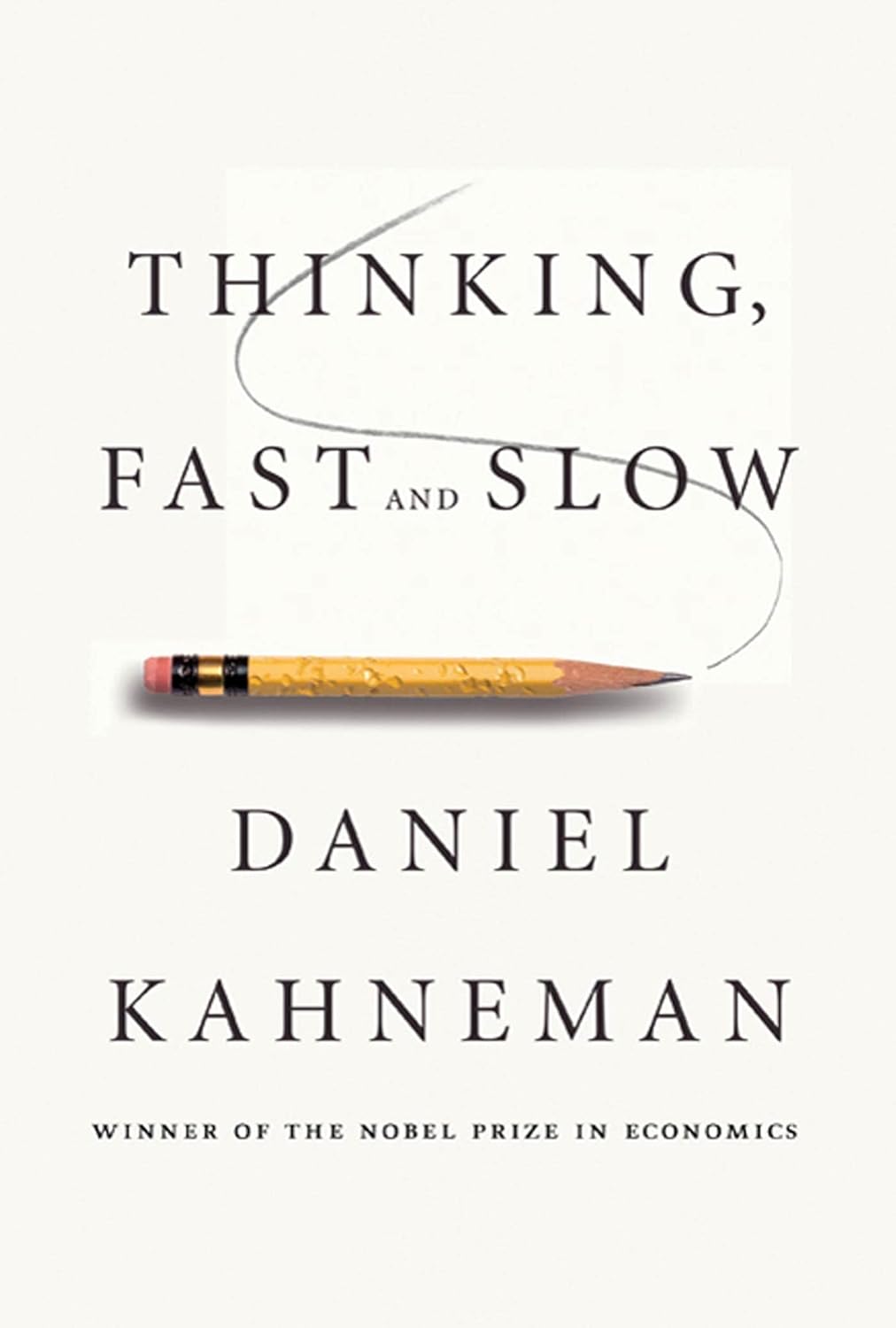
A doctor recommends surgery because the case reminds him of one that went well. An investor sells in a panic the moment the news breaks. A judge denies parole more often before lunch than after. None of them feels like they're making a mistake — each has an internal story that justifies the decision. Daniel Kahneman didn't write about occasional errors. He wrote about the fact that the brain produces flawed judgments systematically, predictably, and without any internal alarm to warn us.
The system starts by dismantling the "Econ," the economic model that assumes rational, stable decision-making. Kahneman, a psychologist and Nobel laureate in Economics, shows that the brain doesn't calculate — it builds coherent stories, and mistakes that coherence for truth.
If you only remember one thing
Your brain doesn't analyze reality — it builds the most coherent story it can from the data on hand, and calls that thinking. The confidence you feel is a sign of coherence, not accuracy.
- System 1 decides first; System 2 almost always just rubber-stamps it.
- Losses hurt about twice as much as equivalent gains feel good.
- Biases can't be eliminated — only the environment can be designed to limit the damage they cause.
Audiovisual analysis
Audiovisual summary and podcast on the book’s central ideas.
Before we begin
The concepts you need to understand the system
The rest of this analysis takes six ideas as already understood. Laying them out here means we won't have to define them again in every section.
System 1 and System 2
What it means: System 1 thinks fast, automatic, and effortless; System 2 thinks slow, deliberate, and requires conscious effort.
Why it matters: System 1 proposes most of our judgments; System 2 almost always just approves them without checking.
WYSIATI
What it means: "what you see is all there is" — the brain builds coherent stories while ignoring the information it's missing.
Why it matters: it explains why we feel confident in judgments built on incomplete data.
Attribute substitution
What it means: when a question is hard, the brain swaps in an easier one and answers that instead, without ever noticing the switch.
Why it matters: it means complex judgments — like "is this profitable?" — often get answered by simple intuitions, like "do I like this?"
Prospect Theory
What it means: we evaluate outcomes as gains or losses relative to a reference point, not as absolute levels of wealth.
Why it matters: it explains why the exact same number can feel like a gain or a loss depending on how it's framed.
Loss aversion
What it means: losing something hurts roughly twice as much as gaining that same amount feels good.
Why it matters: it systematically distorts financial, medical, and negotiating decisions.
The two selves
What it means: the experiencing self lives in the present moment; the remembering self builds the story that's left afterward.
Why it matters: our future decisions are based on that remembered story, not on the actual experience lived.
The shape of the book
Problem
Faulty judgments with no internal warning sign.
Common mistake
Assuming we decide rationally and consciously.
Thesis
The brain mistakes coherence for truth.
Framework
System 1 / System 2 and Prospect Theory.
Application
Spot the minefields and force cognitive strain.
Payoff
Not eliminating bias, but limiting the damage it does.
01 — The central thesis
Why we mistake coherence for truth
We assume that when something really matters, we think it through carefully: we weigh the evidence, compare our options, arrive at a reasoned conclusion. Kahneman shows that this conscious effort almost always shows up late. Before reasoning ever kicks in, part of the brain has already produced an impression — a sense that something is true or false, good or bad.
That fast part isn't badly designed. It's kept us alive for millennia, spotting threats and patterns in a fraction of a second. The problem is that conscious reason rarely questions it. Instead, it builds a story on top of that first impression, a story that sounds coherent — and we mistake that coherence for having thought things through.
Central thesis
The brain doesn't analyze reality: it builds a story that's coherent with the data at hand, and mistakes that coherence for truth.
That's why the experts who trust their own judgment the most aren't necessarily the ones who get it right the most: they're the ones who've built the most convincing stories, even in fields — like the stock market or long-range politics — where there are no real patterns to learn in the first place.
02 — The central mechanism
How a judgment actually gets made
When someone asks you a hard question — is this company a good investment? is this defendant guilty? — what happens in your head isn't what you think. Kahneman lays out a sequence that repeats constantly and that we almost never notice.
Step 1
Hard question
Input
A question arrives that would genuinely require calculation, comparison, or real analysis.
Step 2
Substitution
System 1
System 1 quietly swaps it for an easier question and answers that one instead.
Step 3
Approval
System 2
System 2, running in low-effort mode, checks the answer and almost always signs off on it.
Step 4
Final judgment
Output
The answer is experienced as if it had been reasoned through from the start.
The friction shows up because System 2 rarely catches the switch in question. It only steps in with any real force when something trips an alarm — an inconsistency, a strange piece of data, a deliberate effort to doubt.
03 — The system's components
The system's four pillars
Kahneman organizes the entire architecture of judgment into four pieces that constantly interact with each other.
01
The associative engine (System 1)
Generates impressions, feelings, and inclinations quickly and automatically, building a coherent read on the world in real time.
02
The lazy monitor (System 2)
In charge of complex calculation and executive control, but usually runs in low-effort mode, approving whatever System 1 puts forward.
03
The change evaluator (Prospect Theory)
Measures gains and losses against a reference point rather than absolute wealth, and responds asymmetrically to each.
04
The record-keeping system (the two selves)
Splits utility between the self that lives the present moment and the self that remembers, building the story around the peak and the ending.
04 — The deep layer
How we weigh gains and losses
Underneath System 1 and System 2 sits a second architecture, specific to decisions made under risk, that explains why the exact same information can push us toward opposite conclusions depending on how it's presented.
1
The reference point
We don't evaluate outcomes in absolute terms — we measure them as gains or losses against a starting point, whether that's the status quo or whatever we expected. Shift that reference point, and the exact same outcome feels completely different.
2
Loss aversion
A loss feels roughly twice as intense as an equivalent gain. That asymmetry is why we avoid perfectly reasonable risks when there's something to lose, and why we start chasing risk once we feel we've already lost.
3
The remembering self
When we recall an experience, we don't average out every moment we lived through it — we hold onto the most intense point and how it ended, and we ignore how long it actually lasted. Our future decisions rest on that distorted memory, not on the real experience.
These three pieces explain why phrases like "90% survival" and "10% mortality" — which describe exactly the same figure — lead to different medical decisions: change the frame, and you change the reference point, and with it, the entire decision.
05 — Points of friction
The errors the system produces
System 1's own design produces predictable errors that show up regardless of how intelligent or well-trained the person judging happens to be.
The illusion of validity
We keep trusting judgments that the data itself has already proven useless, simply because the story behind them still sounds coherent.
Anchoring
A number you saw right before deciding contaminates the decision, even when that number is completely random.
The availability bias
We judge how common something is by how easily an example comes to mind, not by its actual probability.
The planning fallacy
We assume our own plan has better odds than similar plans, ignoring the track record of comparable cases.
The book is blunt about an uncomfortable point: these biases don't go away with intelligence, experience, or good intentions. The people who design our institutions suffer from them too, which raises a bigger question about the structures we've built.
06 — Implementation protocol
How to guard against your own judgment
Kahneman isn't asking you to think slowly all the time — that would be exhausting and unsustainable. He's asking you to recognize the specific moments when System 1 is operating in dangerous territory.
01
Spot the minefield
Look for the warning signs: decisions made under time pressure, active emotions, scarce data, or a frame someone else has imposed.
02
Force cognitive strain
Deliberately slow the process down; simple physical cues, like furrowing your brow, boost System 2's vigilance.
03
Take the outside view
Set aside the individual case and ask what happened to a large group of statistically similar ones instead.
04
Run a premortem
Before executing a plan, imagine it has already failed and ask why, to break through initial blind optimism.
05
Design the environment, not your willpower
Replace reliance on individual self-control with checklists and statistical formulas that don't depend on it.
What to remember
- Your brain automatically answers the question it can answer, not the one you were actually asked.
- Confidence in a judgment is a sign of narrative coherence, not of being right.
- Losses hurt about twice as much as equivalent gains feel good.
- The number you saw right before deciding has already contaminated that decision, even if it was random.
- Biases can't be eliminated — you can only design the environment to limit the damage they cause.
What this book doesn't say
It's easy to read Thinking, Fast and Slow as a catalog of cognitive biases to memorize, but the biases are symptoms — the book's real content is a full architecture of human judgment, with implications that reach well beyond individual psychology. It's also not "System 1 bad, System 2 good": Kahneman is explicit that expert intuition is indispensable in domains with real regularities, and that System 2 makes serious mistakes of its own when it's depleted. And it isn't a guide to sustained better thinking: the book argues that conscious control is limited and costly, and that the real solution lies in designing environments, not in individual effort.
Synthesis
Thinking well isn't up to you — it's up to the environment you design
Thinking, Fast and Slow doesn't teach you to reason better on a sustained basis — it teaches you to recognize the exact moments when conscious reason is absent, even as the decision feels entirely reasoned. The mind doesn't analyze reality; it reconstructs it into a story that sounds true.
That reconstruction isn't an occasional glitch in the human brain — it's how the brain normally operates. Accepting that changes the question. It's no longer how to think without bias, but which structures — judicial, financial, medical — we're still living inside that were built by people just as biased as we are.
If biases are systematic, predictable, and shared even by the people who design our institutions, how much of the structures we inhabit are simply the accumulated result of judgment errors nobody ever caught in time?