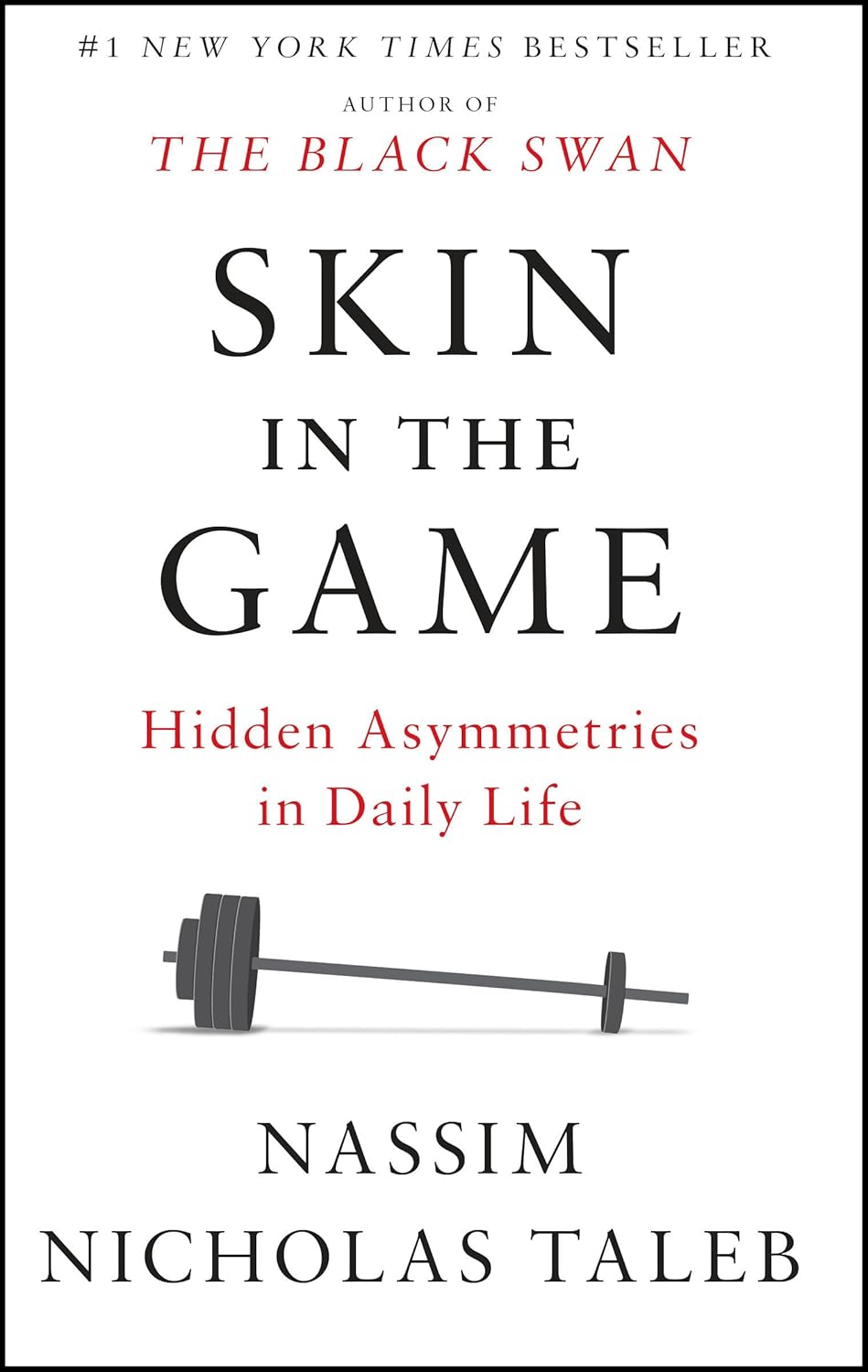
Someone gives advice, signs a report, or votes for a policy — and if it goes wrong, they pay nothing. Their salary continues, their reputation stays intact, their life unchanged. Meanwhile, others — those who were actually exposed to that decision — bear the consequences. Nassim Nicholas Taleb wrote Skin in the Game to name that imbalance and propose a rule as simple as it is uncomfortable: no one should have a say over a risk they don't share.
With this book Taleb closes his series on uncertainty, shifting from the analysis of risk to the moral question underlying it: who pays when something goes wrong. Within Eudaimanya, this book bridges the analytical rigor of The Black Swan with a practical, everyday demand: never trust anyone who has nothing at stake.
If you remember one idea
Those who decide must be able to lose
- An opinion without risk is worth nothing, no matter how convincingly it is delivered.
- Systems don't learn because their members are smart — they learn by eliminating those who fail.
- Surviving matters more than being right, because those who don't survive never get to be right again.
Audiovisual analysis
Audiovisual summary and podcast on the book’s central ideas.
Before we begin
The words that underpin the entire book
Before entering the system, it's worth fixing the terms Taleb uses again and again. None of them is complicated, but each one shifts in meaning the moment it's applied to real life.
Skin in the game
What it means: having something real and personal at stake when making a decision that affects others.
Why it matters: it is the condition that separates genuine knowledge from cheap opinion; without it, no one pays for their mistakes.
Symmetry
What it means: that whoever can benefit from a decision can also be harmed if it goes wrong.
Why it matters: without symmetry, someone always wins and someone else always pays — an imbalance that doesn't correct itself.
Via negativa
What it means: learning by removing what doesn't work, rather than by adding theoretical solutions.
Why it matters: knowing what is false is easier and more reliable than proving what is true.
Ruin
What it means: the point at which a loss is so large there is no coming back from it.
Why it matters: if ruin is possible, no low probability compensates for it — it must be avoided unconditionally, not calculated.
Intellectual Yet Idiot
What it means: a credentialed person who understands the theory but is blind to what that theory produces in practice.
Why it matters: it explains why technically correct decisions so often end in practical disasters.
Lindy Effect
What it means: what has been working for a long time is more likely to keep working.
Why it matters: it offers a simple filter for resisting the new solely because it sounds sophisticated.
Book overview
Problem
Decisions made without skin in the game
Common mistake
Trusting those who opine without risking anything
Thesis
Those who decide must be able to lose
Framework
Symmetry, via negativa, ruin management
Application
Ask what each advisor stands to lose if they're wrong
Outcome
Systemic robustness through elimination
01 — The core thesis
Why an opinion without risk is worth nothing
It's easy to listen to someone who speaks with confidence and give them credit for that alone. An analyst predicting a crisis, a politician promising a reform, an advisor recommending an investment — all speak with equal conviction, whether they're right or not. The common error is evaluating the argument without asking what happens to that person if they're wrong.
Taleb's break is direct: what matters is not what someone says, but what they're prepared to lose. Skin in the game means having something real and personal at stake when making a decision that affects others. If a surgeon operates badly, they risk their reputation and licence; if an academic recommends a failed policy, they typically lose nothing. That difference, Taleb argues, is not a minor moral detail — it determines whether someone's knowledge deserves trust.
Core thesis
Skin in the game... is a filter and detector of bullshit; that is, it detects the difference between theory and practice.
— Nassim Nicholas Taleb, Skin in the Game
The practical consequence is immediate: before following advice, ask what that person stands to lose if they turn out to be wrong. If the answer is "nothing," their opinion is worth considerably less than it sounds.
The diagram above contrasts both positions: the one who opines without exposure to the outcome, and the one who decides knowing they will pay the price if they're wrong.
02 — The core mechanism
How systems learn without reading books
We assume systems improve because the people within them grow smarter: pilots learn from their mistakes, engineers fix their failures. But Taleb points to something more uncomfortable: systems often improve even when the individuals inside them learn nothing at all — simply because those who fail disappear.
This mechanism is the via negativa: learning by eliminating what doesn't work, rather than adding theoretical solutions. Aviation didn't become safer because every person understood aerodynamics better, but because dangerous designs stopped flying and the people behind them stopped operating. It is learning without a teacher, sustained purely by the elimination of the fragile.
Step · 1
Variation
Many different solutions coexist
Different agents try different approaches to the same problem, with varying results.
Step · 2
Risk exposure
Each solution faces reality
Agents with skin in the game suffer directly the consequences of a poor design.
Step · 3
Elimination
The fragile disappears from the system
No one needs to understand why something failed; it simply ceases to exist.
Outcome
Robustness
What remains has proven its resilience
The system is smarter even though no individual within it is any smarter than before.
The diagram below shows the flow: without genuine risk exposure, the elimination phase never occurs and the fragile can persist indefinitely.
Without genuine exposure to risk, the elimination phase never happens and the system stops learning.
The practical implication is that fixing a system's feedback loop — ensuring that those who decide also live with the consequences — matters more than educating its members.
03 — The system's components
Four pillars for demanding skin in the game
Symmetry is not an abstract idea; Taleb translates it into four pillars that can be applied to concrete everyday decisions.
01
Symmetry of outcomes
If someone puts others at risk and those others suffer as a result, the person who created the risk must pay a proportionate price. This is the foundation of the Silver Rule: do not do to others what you would not want done to you.
02
Contact with reality
Valid knowledge comes from direct contact with practice, not from isolated theory. Reality is the only judge that cannot be fooled by language.
03
Learning through elimination
Systems grow smarter by removing the fragile, not by educating each individual. Without this pruning, errors repeat themselves indefinitely.
04
Ruin management
Before any probability analysis, the first question must be whether total ruin is possible. If it is, it must be ruled out — not calculated.
04 — The deep layer
Don't tell me what you think — show me what's in your portfolio
Beneath the four pillars lies a hierarchy of commitment that Taleb builds in layers. Not harming others is not enough; the system distinguishes between different degrees of genuine engagement with the consequences of one's own actions.
Three levels of commitment: the closer to the centre, the more real what the person is risking.
1
Words
What someone says, writes, or predicts. It is cheap to produce and costs nothing if it turns out to be wrong. Taleb calls it bluntly: talk.
2
Portfolio at stake
Portfolio at stake means the person puts their own money or their own security behind what they claim. If they're wrong, they lose something tangible and measurable.
3
Soul at stake
Soul at stake means placing the quality and honour of one's own work above any financial incentive. It is the level of the craftsman who would not sell something defective because it wounds their own pride — not because they fear a fine.
Craftsmen have their soul in the game... they would not sell something defective because it harms their pride — Nassim Nicholas Taleb, Skin in the Game
Recognising which layer someone operates in — or which you yourself do — changes entirely how much credit their words deserve.
05 — Friction zones
When the system fails
The requirement for skin in the game is not a universal rule without nuance. Taleb identifies several areas where applying it badly — or failing to apply it where it belongs — creates its own problems.
The Intellectual Yet Idiot
Understands the theory with precision but is blind to what that theory produces in practice, because they never suffer those consequences themselves.
The Bob Rubin trade
Pocketing the gains when things go well and blaming bad luck — a "black swan" — when the risk that was taken eventually materialises.
Domesticated dependence
Having skin in the game is not always freedom: an employee who depends on a single salary also takes risk, but from a position of submission rather than autonomy.
Naive interventionism
Bureaucrats who attempt to fix complex systems without living with the consequences of their own interventions, breaking self-regulatory mechanisms they don't understand.
The book itself acknowledges its limits: demanding skin in the game in trivial interactions — where no one's opinion affects anyone else's survival — turns a useful principle into an obsession.
06 — Implementation protocol
How to demand symmetry in everyday decisions
The system operates through five moves, all of which can be evaluated without relying on anyone's good faith.
01
Ask what is at stake
Before following any advice or recommendation, identify what that person stands to lose if the advice turns out to be wrong.
02
Rule out ruin
If a decision carries any possibility of total ruin, eliminate it outright — regardless of how low that probability appears to be.
03
Favour direct accountability
Prefer systems where decision-makers can be held directly responsible, over those that conceal risk behind regulatory compliance.
04
Reduce scale
Where possible, favour local and small-scale decisions, where it is harder to hide risk behind distance.
05
Apply the Lindy filter
When faced with two equally convincing solutions, trust first the one that has the longer track record of working.
What to remember
- An opinion without risk is worth nothing, no matter how convincingly it is delivered.
- Systems learn by eliminating the fragile, not by educating each individual.
- If total ruin is possible, it must be avoided — not calculated.
- Not everyone who takes a risk does so from a position of freedom: dependence is also skin in the game, but a domesticated kind.
- Before trusting advice, ask what the person giving it stands to lose if they're wrong.
What this book does not say
The book does not say one should take risks as a matter of principle, or that recklessness is a virtue. Having skin in the game does not mean seeking danger — it means bearing the real consequences of one's own decisions. It also does not call for eliminating all regulation or external intervention: it acknowledges that demanding symmetry is excessive in trivial interactions, where no one else is harmed. And it is not a personal finance manual, even though it draws on financial examples: it is, above all, an ethical framework about who should have a voice in a decision.
Synthesis
Risk something or stay quiet
Skin in the Game is not a book about finance or statistics, even though it touches on both. It is a book about a minimum condition for any decision to merit trust: that whoever makes it can be harmed if they get it wrong. Taleb doesn't ask for heroism or sacrifice — he asks for symmetry.
The shift in perspective the book leaves behind is uncomfortable precisely because it can be applied immediately: every time someone opines, advises, or decides on behalf of others, the question worth asking is how much of themselves they've put on the line. The answer usually says more than the advice itself.
How many of the people whose advice you follow today would lose something real if that advice turned out to be wrong?