
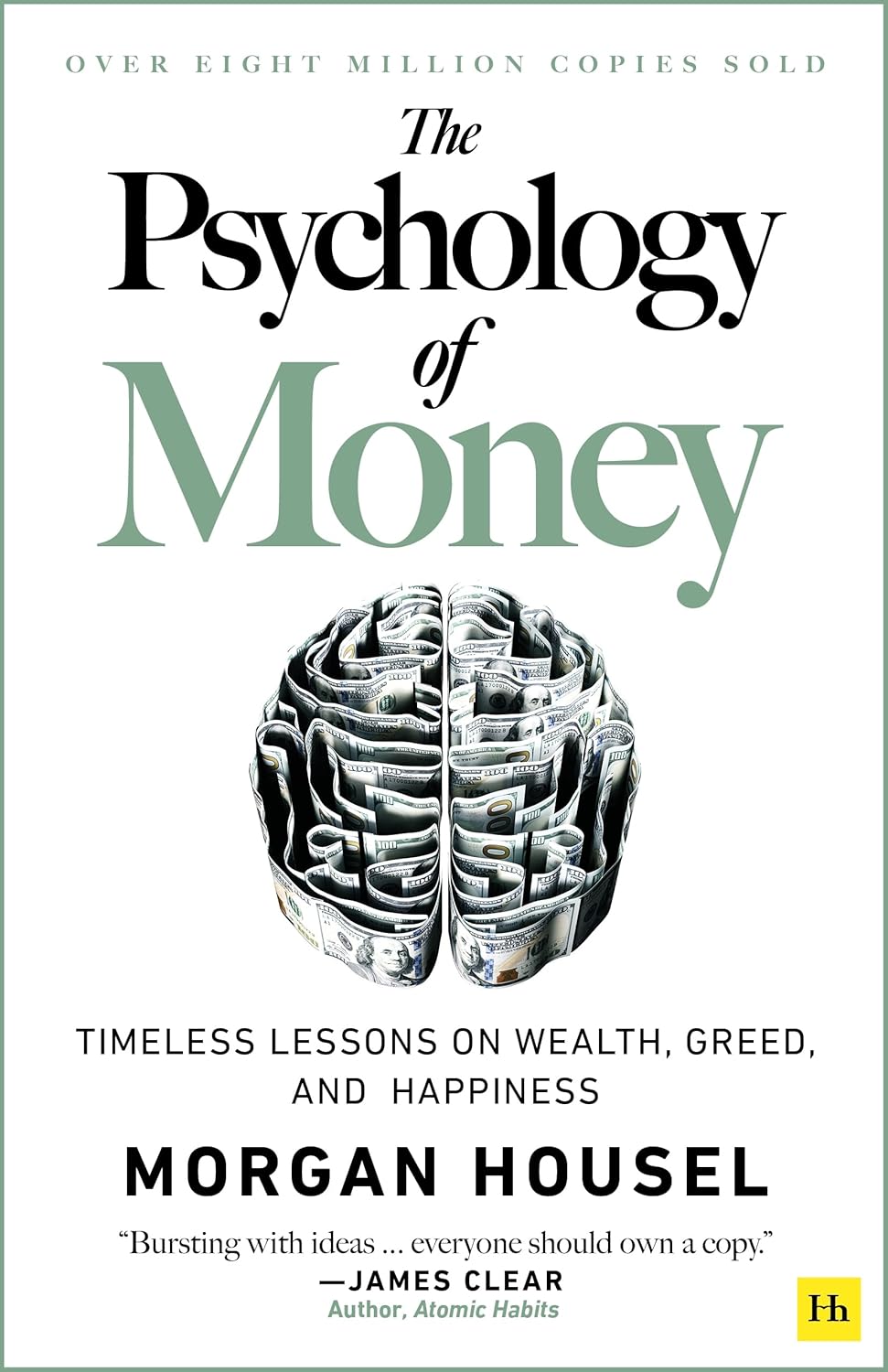
Someone with a decent salary, an education, and good intentions keeps making decisions that ruin them, bury them in debt, or trap them in a job they hate. It isn't a lack of technical knowledge — nobody ever taught them that money isn't managed with formulas, but with emotions they don't even recognize as such. Morgan Housel zeroes in on that exact moment when a smart person does something financially stupid, and can't figure out why.
The system starts from an uncomfortable observation: money gets taught like an exact science, but it actually gets decided by fear, envy, and impatience. Housel, a financial analyst, argues that managing those emotions matters more than mastering the formulas.
If you only remember one thing
Money isn't won by the person who knows the most, but by the one who behaves best when scared. Real wealth is invisible: it's the assets you don't spend, not the ones you show off.
- Financial success is a behavioral skill, not a technical one.
- Saving isn't about depriving yourself of things — it's buying yourself the right to say no.
- Compound interest doesn't require genius, just that you never interrupt it.
Audiovisual analysis
Audiovisual summary and podcast on the book’s central ideas.
Before we begin
The concepts you need to understand the system
The rest of this analysis takes seven ideas as already understood. Laying them out here means we won't have to define them again in every section.
Invisible wealth
What it means: real wealth is the assets you haven't spent, not the ones you show off — what's visible has already stopped being wealth.
Why it matters: mistaking spending for wealth is the root error behind most bad financial decisions.
Savings as the ego gap
What it means: what you actually save is the gap between your income and what your ego needs to display — not a fixed percentage of your salary.
Why it matters: it explains why a raise doesn't always translate into higher real savings.
Margin of safety
What it means: a cushion of redundancy and liquidity that doesn't depend on getting future predictions right.
Why it matters: it's what lets you ride out volatility instead of abandoning the system right before it pays off.
"Shut up and wait"
What it means: compound interest depends on how long your investment survives, not on picking the single best asset.
Why it matters: it turns deliberate inaction into the most profitable strategy over the long run.
Tail events
What it means: a small share of outcomes — barely 1% of the time — drives most financial results.
Why it matters: panicking out of the system usually means missing exactly those events.
Time autonomy
What it means: accumulated capital gets used to control your own time, not to fund status consumption.
Why it matters: it's the system's real dividend — the power to say no.
Luck-risk symmetry
What it means: outcomes are partly shaped by forces outside individual effort — in success just as much as in failure.
Why it matters: it demands humility about your own wins and compassion toward other people's failures.
The shape of the book
Problem
Smart people making financially stupid decisions.
Common mistake
Assuming financial success is a matter of technical knowledge.
Thesis
Whoever behaves best when scared wins, not whoever knows the most.
Framework
Behavioral Resilience System.
Application
Define "enough," save your ego, keep a margin of safety.
Payoff
Full control over your own time.
01 — The central thesis
Why technical knowledge isn't enough
Conventional finance gets taught like a hard science: formulas, ratios, valuation models. Housel points to the flaw baked into that premise from the start: money doesn't get decided with formulas — it gets decided by personal history, fear, envy, and impatience. It's a behavioral skill dressed up as a technical discipline.
That's exactly why technical intelligence can turn into a liability: it breeds overconfidence, and confidence without emotional management produces ruinous decisions — made by people perfectly capable of explaining, after the fact, exactly why they got it wrong.
Central thesis
Money isn't won by the person who knows the most, but by the one who behaves best when scared.
This shifts the center of the problem: away from how much information you have on hand, and toward the quality of behavior sustained over decades — especially in the moments when that behavior is hardest to sustain.
02 — The central mechanism
The chain behind financial resilience
Housel's system isn't a loose collection of rules — it's a chain, where each link depends on the one before it. Skip the first one, and none of the rest ever get a chance to kick in.
Link 1
Survival
Optimism + paranoia
Avoiding total ruin is what lets you stay in the game long enough for the rest to matter.
Link 2
Compound interest
Shut up and wait
Given enough time, how long an investment survives matters more than its annual return.
Link 3
Tail events
Capturing the tails
Staying in the market means you're around to capture the small share of events that drives most of the return.
Link 4
Time autonomy
Final outcome
Accumulated capital turns into control over your own time, not more consumption.
The usual point of friction shows up at that first link: if someone can't manage the short term well, they never get to benefit from what time might otherwise have given them.
03 — The system's components
The system's operating mechanisms
Each link in the chain rests on a specific mechanism that Housel breaks down separately.
01
Margin of safety
Redundancy and liquidity that replace the need to get predictions right. It isn't defensive — it's what makes staying in the game possible at all.
02
Eliminating single points of failure
Never rely on a single source of income or on assets that need a perfect environment to work.
03
"Good enough" returns
Give up hunting for the single best asset in exchange for a sustainable return you can repeat without interruption.
04
The reasonability filter
Favor strategies that are technically imperfect but psychologically sustainable — the goal is sleeping well, not squeezing out every last decimal point.
04 — The deep layer
What wealth actually measures
Underneath the operating chain sits a layer of beliefs about what money really is — and that layer determines whether someone can sustain the system over the long run.
1
Invisible wealth
The system runs on unspent capital. What's visible — cars, houses, clothes — is money that already stopped being wealth the moment it got spent. Confusing consumption with financial success is the root error.
2
Keeping ego in check
Savings aren't a fixed percentage of salary — they're the distance between what you earn and what your ego needs to display. That's why a raise doesn't always mean saving more: status spending tends to rise right along with it.
3
Luck-risk symmetry
No financial outcome is 100% attributable to individual effort. Recognizing that keeps you from overestimating your own skill when things go well, and from judging other people's failures too harshly.
On top of this sits the end-of-history illusion: we underestimate how much our desires and values will keep changing over time, which means a financial plan that's too rigid ends up as a trap our past self sets for our future self.
05 — Points of friction
Why the system falls apart
The system has specific failure conditions, and all of them come down to losing sight of the problem's behavioral nature.
The social comparison trap
The ceiling on comparison is infinite — there will always be someone with more, and chasing them pushes you into unnecessary risks for things you don't actually need.
The historian-as-prophet fallacy
Treating past data as an exact map of the future ignores the fact that the most decisive events are always unprecedented surprises.
The seduction of pessimism
Bad news feels intellectually more compelling and more rigorous, which drives premature exits from the market.
Confusing different games
Copying financial players who operate on completely different time horizons — chasing short-term signals as a long-term investor — breaks the system from the inside.
The book is upfront about this: it isn't offering a foolproof method, but a system with a clear activation threshold and specific conditions under which it fails.
06 — Implementation protocol
How to put the system to work
Putting the system into practice starts with a single decision and holds together through a handful of deliberately simple moves.
01
Define what "enough" means
Set that line and don't move it. This kills the social comparison trap before it even gets started.
02
Save by keeping your ego in check, not your salary
Real savings depend on the gap between your income and what your ego needs to display, not on a fixed percentage.
03
Invest without relying on predictions
Use low-cost index funds as your default tool for staying in the system long-term.
04
Keep a margin of safety
It isn't a conservative luxury — it's what lets you get through moments of terror without abandoning the system.
05
Practice deliberate inaction
When volatility hits — and it will — the right move is usually to not move at all.
What to remember
- Money isn't won by the person who knows the most, but by the one who behaves best when scared.
- Wealth is what you don't see: the assets you haven't spent, not the cars or the houses.
- Real savings are the gap between your income and what your ego demands, not a percentage of your salary.
- Volatility isn't a penalty — it's the price of admission to the game.
- The biggest financial risk isn't losing money — it's running out of options over your own time.
What this book doesn't say
It's easy to read The Psychology of Money as an investing guide, but it doesn't offer a detailed asset-selection system or a technical portfolio of its own — it can point toward simple, diversified tools, like low-cost index funds, consistent with its focus on staying in the game with minimal upkeep, without going into technical selection criteria. Nor is it a universal framework for "everyone's personal finances": the system has an activation threshold and doesn't work below the level of basic survival. And it doesn't boil down to "save more, spend less" — the key variable isn't the amount saved, but the ego that determines it.
Synthesis
Money is a behavior problem, not a math problem
The Psychology of Money doesn't teach you to invest better — it teaches you to stop sabotaging yourself when the market scares you. The whole system rests on holding an uncomfortable contradiction: long-term optimism and short-term paranoia, neither one canceling out the other.
The end result isn't a number in a bank account — it's control over your own time: the ability to turn down what you don't want and to wait for what you do.
If you reached the financial independence you're chasing tomorrow, would you know what to do with your time — or have you spent years using money as an excuse not to answer that question?