
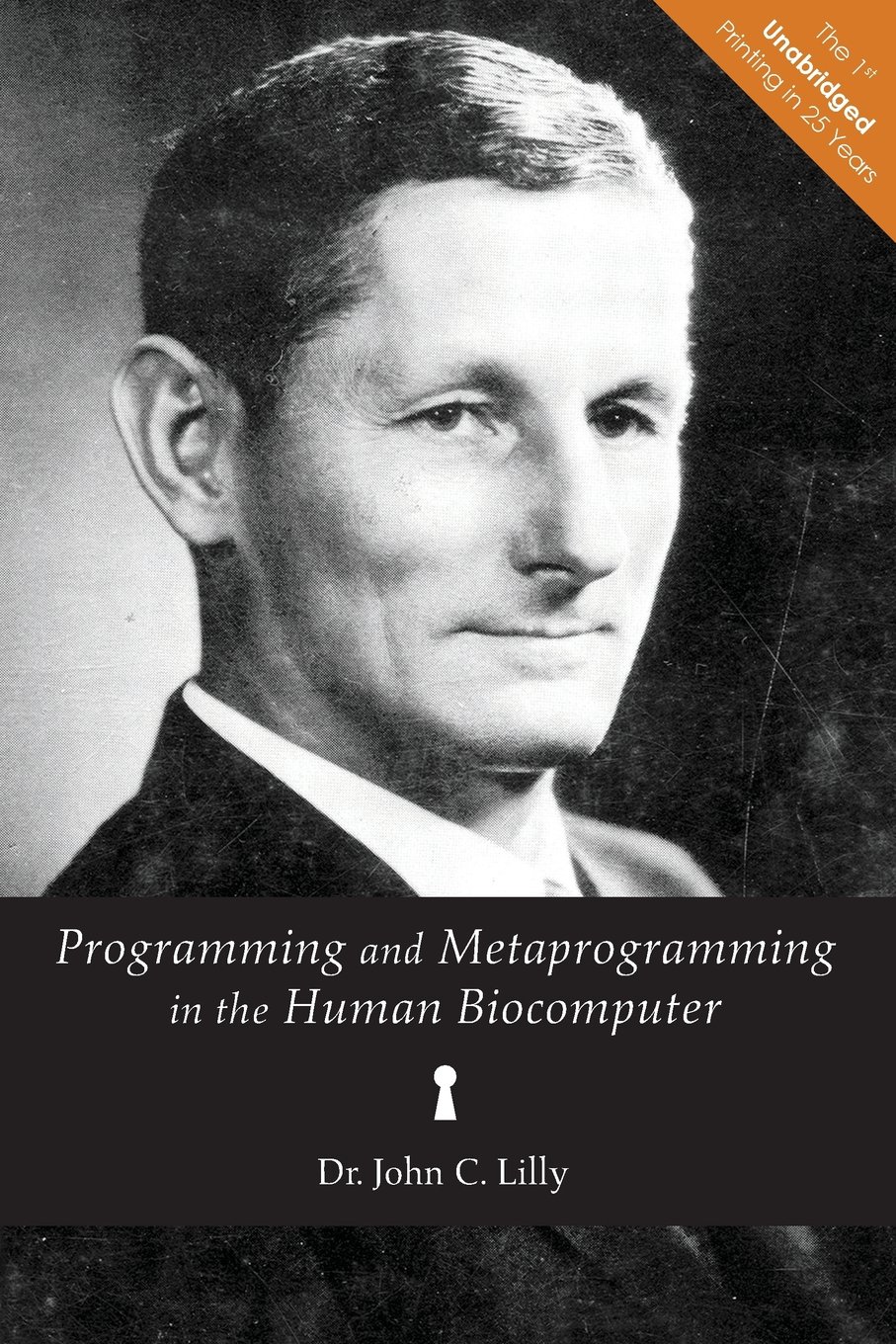
Almost all of us have defended something with total certainty that we had never examined, and felt that the certainty was proof enough. John C. Lilly argues that much of our behavior follows inherited programs and patterns imposed in childhood that operate below the level of awareness, and that feeling certain is not the same as being right. This analysis explains how he proposes to observe that programming and what limits he sets himself.
The book draws on research carried out in the laboratories of the NIMH between 1953 and 1958, with reports written between 1964 and 1966. It matters within Eudaimanya because it helps distinguish the strength of a conviction from how well it fits reality, and it makes clear that its methods are historical testimonies, not recommendations.
If you remember only one idea
According to Lilly, a human being is a programmed biocomputer that can observe and reorganize its own programs, provided it first examines the assumptions from which it interprets experience.
- Certainty and reverence are, for the author, sources of energy, not proof of truth.
- A metaprogram coordinates, and can modify, the programs that run at the same time.
- The mind allows flexibility; the body and the planet impose limits that are not negotiable.
Audiovisual analysis
Audiovisual summary and podcast on the book’s central ideas.
Key concepts
Six ideas for reading Lilly
The book uses a vocabulary of its own. These are the notions worth having clear before going further.
Human biocomputer
What it means: An analogy: the human being as a programmable biological system that processes information. It is not a literal equivalence with a computer.
Why it matters: It is the working model of the whole book, meant to describe thought and behavior in a flexible way.
Program and metaprogram
What it means: A program is an organized set of instructions. A metaprogram is a higher-order structure that coordinates, and can modify, many programs.
Why it matters: It makes it possible to speak of changing one's own patterns, not just running them.
Self-metaprogrammer
What it means: The central control function of the system. It is labeled "I" when it acts on other metaprograms and "me" when others act on it.
Why it matters: It is the instance from which, in the model, one's own programming is reviewed.
Metatheoretical approach
What it means: Analyzing the assumptions from which theories are built and experience is interpreted, before accepting their conclusions.
Why it matters: It keeps us from taking for reality what depends on the starting premise.
Zero-level external reality
What it means: The physical environment and objective conditions that do not depend on the beliefs of the mind.
Why it matters: It marks the limit of what a belief can change.
Consensus science
What it means: The limits found experientially and experimentally and agreed upon among qualified observers.
Why it matters: It separates subjective exploration from what can be considered verified.
Map of the book
Problem
Automatic programs operating below awareness
Common mistake
Taking certainty as proof of truth
Thesis
We are biocomputers that can reorganize their programs
Framework
Physical substrate, programs, metaprograms, and self-metaprogrammer
Application
Examine assumptions before trusting conviction
Outcome
More mental flexibility, with physical limits intact
01 — Central thesis
When certainty proves nothing
Many people discover, sometimes late, that they react automatically: they repeat patterns learned in childhood and defend with great conviction beliefs they never examined. According to Lilly, the adult runs on inherited programs and on patterns imposed in the first years of life, which operate below the level of awareness.
The belief the book challenges is that an intense conviction, whether certainty, faith, or reverence, shows that what is believed corresponds to external reality. Lilly proposes the opposite: those feelings are sources of energy for the biocomputer, not proof that a model fits reality. That is why he recommends first examining the basic assumptions from which experience is interpreted.
Central thesis
According to Lilly, a human being is a programmed biocomputer that can observe and reorganize its own programs, provided it first examines the assumptions from which it interprets experience.
The author puts it plainly: all adults are programmed biocomputers, and no one can escape that nature. The proposal is not to deny the programming but to learn to observe it.
02 — Main mechanism
From inherited programs to learning to learn
Think of a reflex you did not choose: you react before you decide. A built-in program here means a fixed pattern, rooted in heredity and aimed at survival. According to Lilly, the nervous system reflects its evolutionary history, from sessile protozoans, sponges, and corals through reptiles, proto-mammals, and primates to man.
On that substrate, the book states, metaprograms imposed from outside are implanted in childhood and persist into adulthood without our noticing. When they act without review, intense subjective convictions take over thought and behavior.
The expansion of the cerebral cortex made possible, according to the author, learning to learn: there is no longer any need to repeat symbols, models, and metaphors each time, and from this metaprogramming arises. In the book's words, a central control system governs hundreds of thousands of programs running in parallel.
The diagram summarizes the levels the model distinguishes, from the physical substrate to the instance that observes and reorganizes.
It is worth remembering that this is an analogy. Lilly separates the physical substrate, an assembly of some ten billion neurons, from the functional organization, and he does not equate the mind with an electronic computer.
03 — Main components
The parts of the biocomputer
The book presents a structure that is explicitly the author's own, with five components running from the material substrate to cosmological models.
01
Physical substrate
The brain and body structures that make information processing possible. The book describes it as a parallel processor that no artificial machine had matched.
02
Functional organization
The programs: sets of instructions stored in memory, activated by internal or external stimuli.
03
Metaprogramming
A higher-order structure that supervises, selects, coordinates, and modifies individual programs.
04
Self-metaprogrammer
The central control function. It is "I" when it acts on other metaprograms and "me" when others act on it. The text makes clear that it does not amount to a single demonstrated neurological center.
05
Supra-metaprograms
Levels of control above the individual, modeled "as if" they were cosmologies or entities. Experiencing them does not guarantee that they correspond to an objective reality.
One path of development that Lilly mentions is to centralize control in the self-metaprogrammer and subordinate to it the other "I"s that usually share command, which, according to the model, reduces inner conflict.
04 — Deeper layer
Self-observation, interlock, and consensus science
To examine stored programming, Lilly describes an isolation environment: the flotation tank, which eliminates external sensory impressions, human interaction, and the effects of gravity on the nervous system. In that state, inner cognition space becomes the field of exploration, with projection and display techniques and a "blank screen" on which subjective contents appear.
The book also records the use of LSD-25 in research at the NIMH and the U.S. Navy, which, according to the author, would introduce small doses of randomness or "noise" and open up the stored programs. These accounts are historical reports, and the text leaves the exact physiological mechanism unspecified.
The model extends to the interpersonal. Coalitions are forms of coordination among biocomputers, from the parental coalition, which persists as internalized instructions even after the parents' death, to sociocultural and artifact coalitions. Participant interlock describes the reciprocal interaction between two or more biocomputers, which Lilly also applied to his work with dolphins.
Finally, consensus science arranges three levels: unlimited information in the individual mind, agreed limits in a network of minds, and unavoidable physical limits in the network of bodies on the planet, agreed upon by qualified observers.
05 — Limits and failure conditions
Limits, risks, and what the book does not demonstrate
The book sets its own boundaries and leaves several questions open.
Mind and body don't follow the same rules
In the domain of the mind, what one believes can turn out to be true within certain limits still to be found through experience. In the body and the planet there are restrictions that no belief changes.
Risks of self-exploration
The author documents uncontrolled activation of protohuman survival patterns, migraines, evasions of analysis, and disorientation without experienced companions.
Reports of their time
The accounts come from the NIMH laboratories (1953–1958) and from reports of 1964–1966. The author explains that the original text included a dense introduction, the "Hidden Message," meant to deter the casual reader and to protect funding and his colleagues.
Gaps left open
The sources do not specify how archaic programs are stored or how the substances act, nor do they offer verified empirical evidence that a language with syntax was decoded in dolphins.
For all these reasons, these accounts should not be read as clinical protocols or as recommendations of general application.
06 — Application
How to use the framework without turning it into a recipe
The book does not offer a closed procedure for the reader. What it shifts is attention: from the content of a belief to its starting assumptions and to the emotional energy that sustains it. Drawing on its ideas, these questions can be asked.
01
Tell intensity from fit
Faced with strong certainty, ask whether it fits external reality, not just whether it feels true.
02
Examine the basic assumptions
Ask which premises the interpretation rests on before accepting its conclusions.
03
Separate mind and body
Recognize what belongs to the domain of the mind and what to the physical restrictions that are not negotiable.
04
Watch for evasions
Notice the detours that Lilly interprets as obstacles to self-observation.
What to remember
- For Lilly, every adult is a programmed biocomputer.
- Certainty and reverence are sources of energy, not proof of truth.
- Examining basic assumptions comes before accepting conclusions.
- The mind is flexible; the body and the planet impose limits.
- The biocomputer is a working metaphor, not a literal description.
What the book does not say
A hasty reading concludes that whatever one believes becomes true. Lilly confines this to the domain of the mind and to certain limits still to be discovered, and he excludes the body and the planet. Nor does he present his methods as a guide to self-experimentation: they are historical reports with documented risks.
Synthesis
Observe the programming before trusting conviction
Lilly proposes changing the question: not "how certain do I feel?" but "what assumptions am I interpreting from, and how well does that fit reality?" In his framework, the strength of an experience does not replace verification.
That view has a broader implication: mental flexibility and empirical discipline do not exclude each other, because each marks out the field where the other makes sense.
If the intensity of a conviction doesn't prove it true, how does a person tell what is true from what merely holds them up from within?