
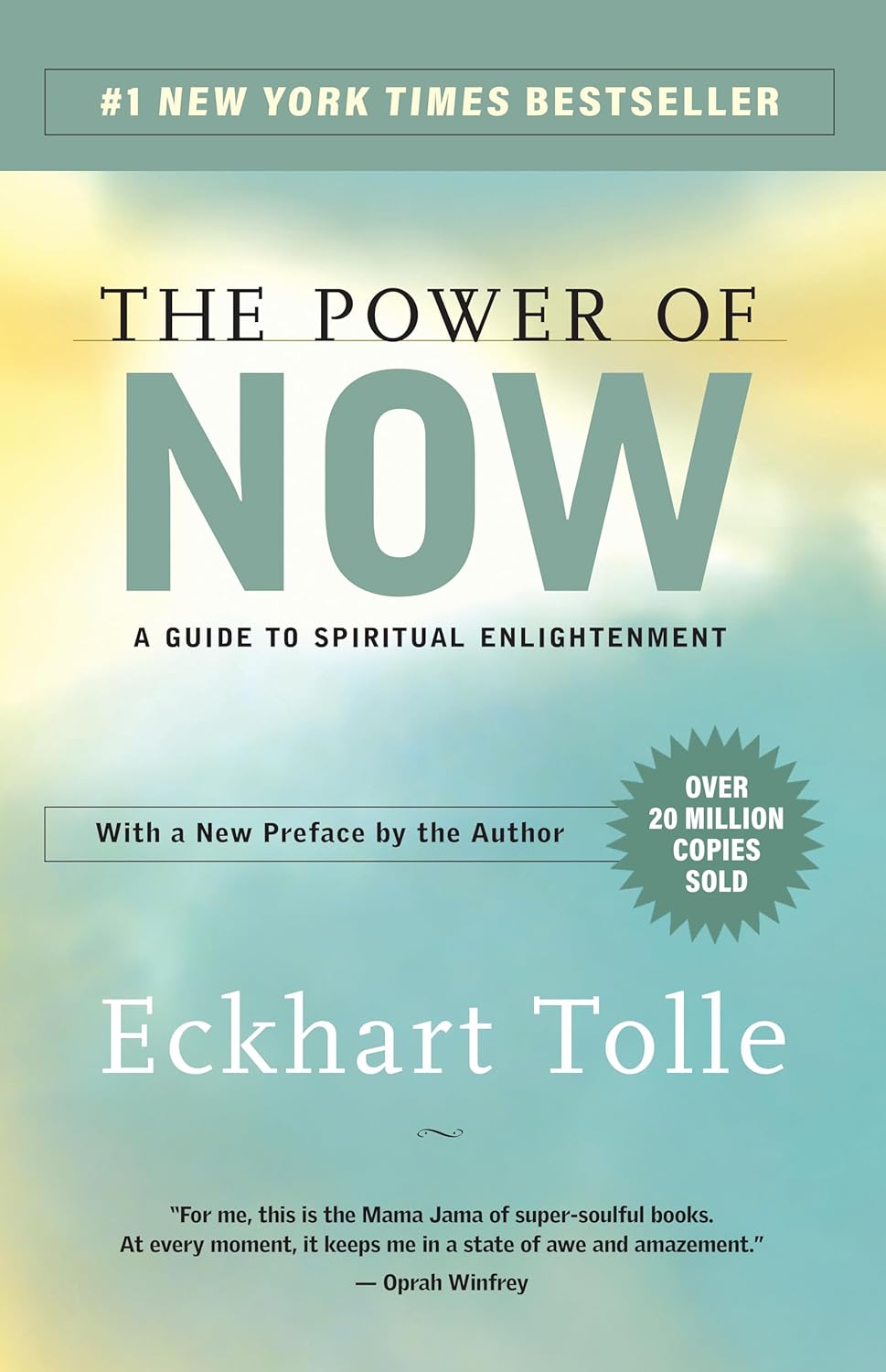
There's a voice in your head that never stops commenting on what happened and what might happen next, leaving almost no room for what's actually happening. Eckhart Tolle argues that this voice isn't a healthy feature of the mind — it's a form of addiction so widespread that almost no one thinks to question it.
Tolle builds these ideas out of a personal experience of radical transformation, not academic research, and he proposes something different from simply improving your thinking: stepping outside your identification with it entirely. That's what earns this book its own place at Eudaimanya — among the titles that change what fills your mind rather than questioning the instrument of thought itself.
If you only remember one idea
According to Tolle, suffering doesn't come from what happens to you — it comes from fully identifying with the voice that won't stop narrating it.
- The very thought analyzing your distress may be the thing keeping it alive.
- Unresolved emotional pain doesn't vanish — Tolle argues it lodges in the body and waits its turn.
- The mind needs the past and the future to sustain itself; the now leaves it with nothing to hold onto.
Audiovisual analysis
Audiovisual summary and podcast on the book’s central ideas.
Key concepts
The book's essential vocabulary
Before diving into the analysis, it helps to pin down six terms Tolle returns to again and again. None of them is jargon for jargon's sake — each one names something you've already experienced, even if you never had a word for it.
The Ego
What it means: the phantom self the mind creates by identifying with its own thoughts, memories, and projections.
Why it matters: Tolle points to it as the source of chronic insecurity and a constant need for validation.
The Now
What it means: according to Tolle, the only reality there is; past and future are mental constructs with no existence of their own.
Why it matters: the book holds it up as the sole point of access to Being.
Psychological Time
What it means: living lodged in memory or anticipation, as distinct from the practical "clock time" used to get things done.
Why it matters: Tolle describes it as the ground where guilt and anxiety take root.
The Pain-Body
What it means: Tolle's term for accumulated emotional residue that behaves almost like an entity of its own inside the body.
Why it matters: it accounts for outsized reactions that actually have little to do with the present moment.
Presence
What it means: a state of conscious alertness in which you watch your own thoughts without identifying with them.
Why it matters: for Tolle, it's the vantage point from which the ego's grip dissolves.
Surrender
What it means: internally accepting whatever is happening in this present moment, without that amounting to passive resignation.
Why it matters: Tolle frames it as the path to acting from clarity instead of from reaction.
The book's arc
Problem
Living at the mercy of a mental voice that never stops commentating
Common mistake
Believing that thinking harder about your distress will resolve it
Thesis
Suffering comes from identifying with the Ego, not from the facts themselves
Model
Presence, dissolving psychological time, and surrender
Application
Watch your thoughts, anchor in the body, accept the present moment
Outcome
A peace that, per the book, doesn't depend on your life circumstances
01 — The central thesis
Mistaking thinking for existing
Most people take a busy, analytical mind as a sign of health — thinking things through, replaying the past, planning the future. Tolle argues that this nonstop thinking isn't functional at all but compulsive: you can't simply choose to switch it off, which makes the mind something closer to a structural addiction.
The Ego, in this sense, is the self you build when you identify with that stream of thought until you mistake that voice for who you actually are. Seen this way, the dysfunction isn't a one-off glitch but the root of anguish itself: you go looking for your sense of identity in thought, and that's exactly where it "becomes the egoic mind and takes over your life."
Central thesis
El Ser es la Vida Una, eterna y omnipresente... No trates de comprenderlo con la mente... Solo puedes conocerlo cuando la mente está en silencio.
— Eckhart Tolle, The Power of Now
The break Tolle proposes isn't a better analysis of the problem — it's stepping outside the very ground where the problem gets generated in the first place. As long as the analysis keeps happening inside the same mind producing the distress, that route offers no real way out.
02 — Time as the ego's life support
Why the mind needs the past and the future
To understand why the mental noise is so hard to escape, the book draws a line between two kinds of time. Psychological time here means living lodged in memory or anticipation — something quite different from plain "clock time," which simply helps organize practical life.
The past, Tolle argues, is nothing more than a memory reactivated in the present; the future is "an imagined now." Neither one has any existence outside this instant — and yet the ego depends on both: on the past to prop up its narrative identity, on the future to promise a salvation that never arrives. That's why the mind treats the bare present as a threat that would shut its whole operation down.
This splitting of time doesn't just prop up the ego — the book treats it as the very ground where accumulated pain finds room to keep projecting itself, over and over.
03 — The pieces of the model
How identification with the mind sustains itself
To lay out clearly how this dynamic operates, the book's ideas can be organized into four areas that reinforce one another: the ego, psychological time, the pain-body, and the resistance to letting go of both.
01
The Ego
The phantom self that feeds on thoughts, memories, and projections, and lives in perpetual need of validation.
02
Psychological Time
The narrative space where the ego projects itself backward and forward, avoiding the one ground where it can't sustain itself: the now.
03
The Pain-Body
Tolle's term for an almost self-sufficient emotional residue that activates around matching triggers and seeks to feed on more conflict.
04
The Ego's Resistance
Attachment to a victim identity or to familiar suffering, which makes letting go of mental control feel like a threat rather than a relief.
The Pain-Body deserves its own treatment, since Tolle describes it in strikingly specific language: he calls it an "alien entity" or an "insubstantial ghost," something that only survives as long as it isn't directly observed. It activates whenever something in the present resonates with an old wound, and in that state — per the book — it seeks to make the person generate or receive more suffering to keep itself going.
04 — Being and enlightenment
What remains once the ego dissolves
Beneath this whole mechanism, Tolle locates a layer that has nothing to do with thought at all: Being, described as the one Life, eternal and all-pervading, underlying every biological form. The mind can't reach it by analyzing it — the book insists that "you can only know it when the mind is silent."
This leads Tolle to redefine enlightenment itself: not as some rare achievement reserved for the few, but as recovering a state that's already available right now. He even explains why spiritual figures have stayed silent about what lies beyond the end of suffering — so the mind wouldn't turn it into just another abstract belief standing in for the real experience.
1
No-Mind
A state of consciousness without thought that, for Tolle, is the only ground on which thinking gains real creative power.
2
Presence
The state of alertness in which you watch your own thoughts without merging with them, breaking the identification with the ego.
3
Being
The indestructible essence that depends on no form or circumstance, reachable only through the mind's silence, never through understanding it.
"No-mind is consciousness without thought. Only the no-mind can think creatively, because it gives thought real power." — Eckhart Tolle
05 — Where presence breaks down
The resistances the book itself acknowledges
The system Tolle describes doesn't fail for lack of intellectual understanding — it fails against very specific resistances that the author himself identifies.
Attachment to a victim identity
Letting go of the suffering narrative, the book suggests, feels like losing your own identity rather than finding relief.
The pull of collective unconsciousness
Tolle points to the pressure of social and media structures that keep reinforcing identification with the mind.
A critical threshold of suffering
In many cases, Tolle argues, the ego only gives way once the pain grows so intense that the resistance collapses on its own, not through a conscious decision.
Turning presence into another theory
If readers only try to grasp these ideas intellectually, the book warns that the mind can never turn Being into an object of knowledge.
The book is explicit that this collapse of resistance, in many cases, doesn't arrive through rational persuasion but through real exhaustion in the face of one's own suffering — a limit that isn't simply a matter of the reader's willpower.
06 — Gateways into the now
Concrete ways to practice presence
Tolle doesn't lay out a numbered step-by-step plan, but he does describe concrete, repeatable ways into a quieter mental state — what he himself calls gateways into the Unmanifested.
01
Anchor your attention in the inner body
Feel the energy field animating the organism from within, as a way of pulling attention away from constant thinking.
02
Listen to the silence behind the sound
Direct your attention to the silence that surrounds and underlies any sound, rather than to the sounds themselves.
03
Notice the space, not just the objects
Turn your awareness to the emptiness that allows physical objects to exist, instead of fixing it only on the solid things themselves.
04
Surrender to this exact moment
Accept internally whatever is happening right now, without any general resignation, before deciding what action to take.
What to remember
- Suffering doesn't depend on the facts — it depends on identifying with the voice narrating them.
- The thought analyzing your distress may be the very thing keeping it alive.
- The ego needs the past and the future to sustain itself; the now gives it nothing to hold onto.
- Unresolved emotional pain doesn't disappear — Tolle argues it settles in the body and waits its turn.
- Letting go of resistance almost always takes real exhaustion, not just intellectual understanding.
What this book doesn't say
The Power of Now isn't telling you to stop feeling, planning, or remembering — it's telling you to stop living as though the past or future were the whole of reality. The "pain-body" is a concept of Tolle's own devising, not an established medical term, and the surrender he describes isn't passive resignation to a life you dislike, but accepting the present moment so you can act with clarity.
Synthesis
A peace that doesn't depend on what happens
The book doesn't promise to fix your life situation — it promises to change the place from which you live it. As long as the mind remains the mandatory filter for every experience, Tolle argues, any calm you find will stay temporary, contingent on things going your way.
That doesn't make action in the world irrelevant — it changes it at the root. You'd be acting from the clarity of the present moment instead of from the reactivity of an ego that needs to defend itself or be right.
If you no longer needed the past to explain you or the future to save you, what would be left of the story you tell about yourself?