
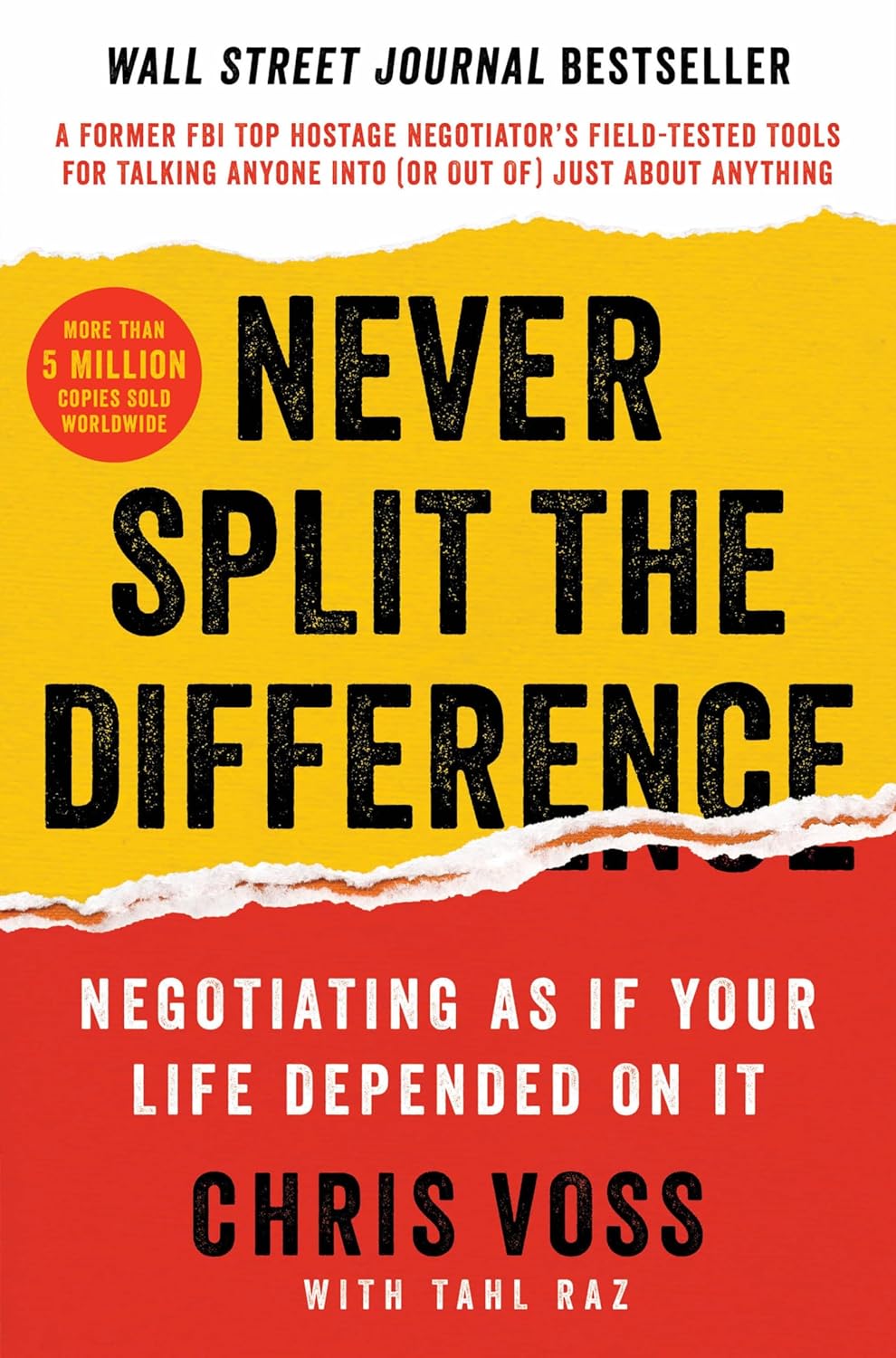
Every time someone needs something from another person — a raise, a fair price, a child to go to bed — they make the same mistake: they believe they can convince someone with arguments who is actually deciding from fear. Chris Voss, FBI hostage negotiator, breaks with decades of classical theory by demonstrating that reason never wins a negotiation on its own. What follows is the system he used with kidnappers, translated to any conversation where someone needs to say yes.
The system grew out of FBI hostage negotiations, where arguing or conceding is not an option: only what actually changes the other person's decision works. Voss later translated that same method to business, sales and daily life.
If you remember only one idea
You never convince someone with logic who decides from fear: listening, naming their emotion and letting them say "no" opens more doors than any argument.
- "No" does not close the negotiation: it opens it.
- "You're right" is a polite exit; "That's right" is a real commitment.
- Real power is almost never solely in the person in front of you.
Audiovisual analysis
Audiovisual summary and podcast on the book’s central ideas.
Before we begin
The concepts you need to understand the system
Before entering the full architecture, it is worth fixing six pieces. The rest of the analysis takes them as given.
Tactical Empathy
What it means: structured listening, almost like a martial art, to disarm the other person without conceding positions.
Why it matters: it is the axis that holds all the other techniques together; without it, none of them work.
System 1 and System 2
What it means: the fast, emotional mind that decides first, versus the slow, logical one that only justifies afterward.
Why it matters: negotiating while speaking only to System 2 means negotiating blind with the one who actually decides.
Mirroring
What it means: repeating the other person's last words to make them keep talking and develop their idea.
Why it matters: it opens up information without the other person feeling interrogated.
Labeling
What it means: naming aloud, in the third person, the emotion you detect in the other person.
Why it matters: it defuses fear or distrust before it can block the conversation.
Calibrated questions
What it means: open questions using "what" or "how" that transfer the problem to the other person.
Why it matters: the other person spends their energy solving your problem instead of arguing about it.
Mastering "No"
What it means: triggering a "no" from the other person so they feel they control the conversation.
Why it matters: without that sense of security, a real agreement is never reached.
The book's journey
Problem
We negotiate as if the other person decides with logic.
Common error
Seeking the quick "yes" and the midpoint.
Thesis
You convince by listening, not by arguing.
Framework
Tactical Empathy.
Application
Mirroring, labeling, calibrated questions, "That's right."
Result
Agreements that are kept, not just signed.
01 — The central thesis
Why logic loses negotiations
Most people enter a negotiation armed with data, comparisons and good arguments, assuming the other person will evaluate them calmly before deciding. That is the premise that dominates classical negotiation theory, inherited from projects like Harvard's: the human being as a rational actor seeking to maximize their benefit.
Chris Voss breaks with that premise from his experience negotiating with kidnappers, where there is no margin for miscalculation. Another person's decision does not originate in the logical part of the brain — it originates in the emotional part. Talking only to reason is like trying to convince someone who is not listening to you.
Central thesis
Entering a negotiation without the tools to read and understand the emotional subtext is like trying to make an omelette without knowing how to crack an egg.
— Chris Voss, Never Split the Difference
That is why the book also dismantles the other great myth of negotiation: that splitting the difference is a reasonable gesture. Voss compares it to wearing one black shoe and one brown one — nobody would choose it if they had the option. You end up there only out of laziness or fear of continuing to argue.
02 — The central mechanism
The mechanism: how trust is built
If the decision is made in the emotional arena, the negotiator's first job is to enter it without putting the other person on the defensive. Voss describes a concrete and repeatable sequence for achieving this, which begins long before anything about the substance is said.
Step 1
Tone of voice
Late-night FM voice
A deep, slow, descending tone conveys calm and control, and defuses the other person's initial alert.
Step 2
Mirroring
Mirroring
Repeating their last words pushes them to explain themselves better, without feeling pressured.
Step 3
Labeling
Labeling
Naming their emotion aloud diffuses it if it is negative and reinforces it if it is positive.
Step 4
"That's right"
That's right
A summary combining what was said with the detected emotion triggers the phrase that marks the real turning point.
The result this sequence seeks is not for the other person to say "you're right" — a polite escape phrase that commits to nothing — but to say "that's right," acknowledging that the negotiator has understood their world as they live it.
The usual friction point appears when the negotiator confuses both responses: celebrating a "you're right" thinking they have won, when in reality the other person just wanted to end the conversation.
03 — The system components
The tools of the system
Beyond the central sequence, the system includes specific tools for concrete situations: managing resistance, detecting deception or extracting information the other party had no intention of revealing.
01
Mastering "No"
Triggering questions that invite a "no" — such as "is this a bad time to talk?" — gives the other person the sense of control needed to keep negotiating seriously.
02
Calibrated questions
Questions starting with "what" or "how" — never "why," which sounds accusatory — transfer to the other person the burden of solving the problem.
03
The 7-38-55 rule
Only 7% of a message is the words; 38% is tone and 55% body language. When they do not match, there is something to label.
04
Extracting black swans
In every negotiation there are three to five hidden pieces of information that, when brought to light, completely change the balance of power.
04 — The deep layer
What sustains the method underneath
Behind the techniques lie three foundational ideas that explain why they work, and that are worth understanding to avoid applying them mechanically.
1
The mind that decides first
System 1 here means the instinctive and emotional part of the mind — the one that decides before reason enters the scene. System 2 only justifies afterward what System 1 has already decided. That is why the order of the conversation matters: first you must influence System 1, and only then does it make sense to speak to System 2.
2
What is lost weighs more
A potential loss is felt with twice the intensity of an equivalent gain. That is why it is not enough to show what the other person will gain from an agreement: you must show them, with precision, what they will lose if the negotiation breaks down.
3
The power that is not seen
Leverage here means the real capacity to move the other person, and it is not always where it seems. It can be positive (giving or withholding something the other wants), negative (damaging their reputation) or normative (using their own moral rules to demand consistency).
"To gain leverage, you must persuade the other party that they will lose something concrete if the negotiation breaks down." — Chris Voss
These three ideas also explain why the system demands so much self-control: if the negotiator themselves reacts with anger or impatience, they activate in the other person the same emotional alarm they are trying to calm.
05 — Friction zones
When the system fails
Tactical Empathy is not infallible. Voss identifies concrete conditions in which the method stops working, and knowing them is as important as knowing the techniques.
The negotiator loses control
If the negotiator themselves reacts with anger, haste or arrogance, they activate the other person's alarm and break the channel of influence in an almost irreversible way.
Ignoring whoever decides off the table
Closing a deal with the person present is useless if there are committees, partners or family members with veto power who were never included.
Negotiating without a direct channel
By email, tone of voice and body language are lost, and the other party is given too much time to cool down and resist.
The book itself acknowledges this limit: the system requires rich, real-time interaction. Without it, many of its most powerful tools simply have nowhere to be applied.
06 — Implementation protocol
How to apply it: the Ackerman bargain
For purely price-based negotiations, Voss proposes a concrete mathematical protocol: the Ackerman model, designed to avoid the most common error of ending up at the midpoint.
01
Set your target price
Define an ambitious but realistic number before starting to talk figures.
02
Anchor at 65%
Your first offer should represent 65% of your target, to anchor the other person's expectation in an extreme way.
03
Raise in three decreasing increments
Calculate increases to 85%, 95% and 100% of your target, each smaller than the previous.
04
Force counteroffers before moving
Use tactical empathy and "how?" questions to make the other person move first.
05
Close with odd numbers
On your final offer, use a precise, non-round number — for example 37,893 instead of 38,000 — to convey rigor.
06
Add something non-monetary
In the final offer, add a low-cost element for you but valuable for the other person, as proof that you have reached your limit.
When the negotiation is not about price but about a decision — closing a deal, changing a behavior, resolving a conflict — the protocol changes form: the Rule of Three requires obtaining the other person's commitment three times, with three different tools, before considering the agreement closed.
What to remember
- "You're right" is the worst response you can receive in a negotiation.
- "No" is not a rejection: it is the signal that the other person is starting to feel safe.
- Repeating the other person's last three words forces them to explain themselves better without realizing it.
- Asking "why" sounds like an accusation; asking "how" sounds like collaboration.
- Real power is almost never solely in the person sitting across from you.
What this book does not say
It is easy to read Tactical Empathy as a catalogue of manipulation tricks, but the system itself depends on the listening being real: feigning interest or simulating an emotion breaks trust irreversibly the moment it is detected. Nor is it a guaranteed method to "always win": the book is explicit that a bad deal is still worse than no deal, and that there are negotiations — without a direct channel, without access to whoever really decides — where the system simply cannot be applied.
Synthesis
Listening as a form of power
Never Split the Difference does not teach you to speak better — it teaches you to listen in a way that changes what the other person is willing to do. Negotiation stops being a clash of arguments and becomes a process where the other person's security — their right to say "no," their need to feel understood — is the real lever.
That means giving up speed and the sensation of immediate control, precisely when urgency pushes in the opposite direction. It is a system that demands more patience than most people are willing to give.
What if what we call "being reasonable" in a negotiation is, in reality, the most effective way to lose?