
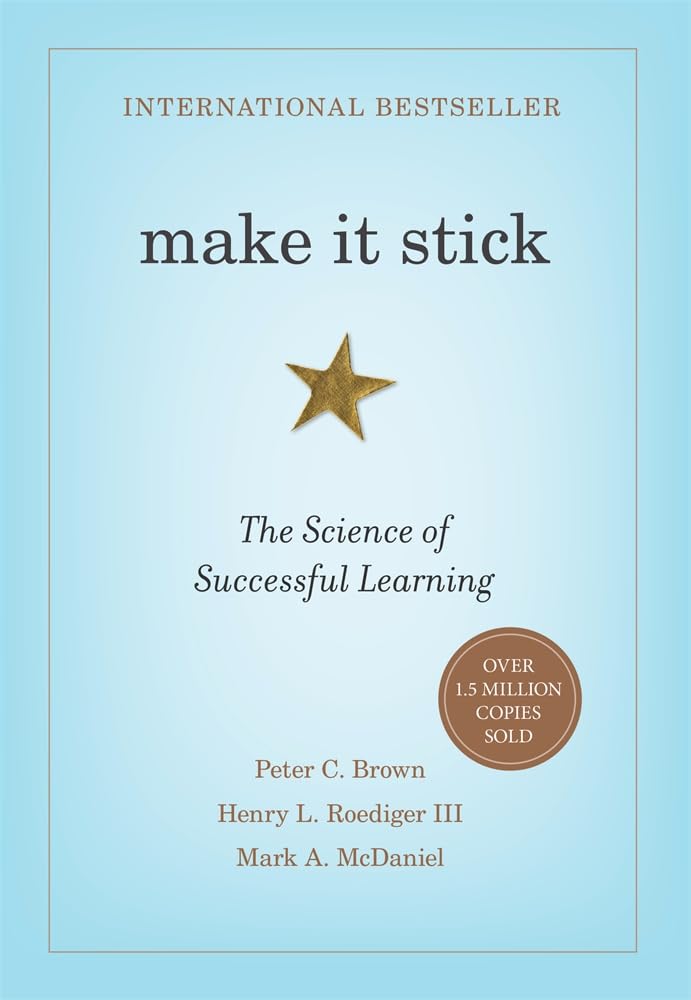
Someone reviews their notes over and over, growing increasingly confident about the material — and yet goes completely blank when they actually need it: in the exam, in the meeting, in the operation. Peter C. Brown, Henry L. Roediger III and Mark A. McDaniel spent years researching why the feeling of mastery and actual mastery are different things, and what it takes for learning to survive the passage of time.
The book grew out of a collaboration between a writer and two cognitive psychologists who had spent decades researching how memory forms. Its starting point is not an opinion about studying, but a body of evidence about why the most intuitive methods are often the least effective.
If you remember only one idea
What you remember is not what you reviewed most often, but what cost the most effort to retrieve.
- Ease while studying is a warning sign, not a sign of progress.
- Retrieving information from memory, without looking at the material, is what strengthens the memory trace.
- Spacing, mixing and explaining in your own words costs more — and that is why it works better.
Audiovisual analysis
Audiovisual summary and podcast on the book’s central ideas.
Key concepts
The vocabulary of effort that learns
Before entering the system it is worth fixing six terms the book uses with more precision than everyday study language.
Retrieval practice
What it means: forcing memory to extract a piece of information instead of re-reading it — closing the material and trying to recall it from scratch.
Why it matters: it is the mechanism that strengthens the pathway to that memory; without retrieval there is no real consolidation.
Desirable difficulty
What it means: the level of effort that, though uncomfortable, fits what the learner can already handle.
Why it matters: it distinguishes the effort that builds memory from effort that only generates frustration without foundation.
Spaced practice
What it means: spreading study out over time, allowing some forgetting to occur before attempting again.
Why it matters: the effort of retrieving something partially forgotten reconsolidates the memory more strongly than reviewing while it is still fresh.
Interleaved practice
What it means: alternating different topics or problem types within a single session instead of exhausting one before moving to the next.
Why it matters: it trains the ability to recognize what type of problem you are facing, not only how to solve it.
Elaboration
What it means: explaining in your own words how the new material relates to what you already knew.
Why it matters: it anchors new knowledge to existing structures instead of leaving it isolated and fragile.
Mental models
What it means: sets of ideas or sequences that fuse into a single unit of intuitive action.
Why it matters: they allow fast and accurate responses under pressure, without reasoning through every step from scratch.
Book map
Problem
Confusing familiarity with text for actual mastery of content.
Common error
Constant re-reading and intensive study of a single topic before moving to the next.
Thesis
What costs effort to remember is what sticks; ease is a warning sign.
Framework
Retrieval, spaced, interleaved and elaboration — desirable difficulty as the engine.
Application
Close the material, self-test, space sessions, mix topics, explain in your own words.
Result
Habit strength: transferable knowledge, available even under pressure.
01 — Central thesis
The illusion of fluency
Almost everyone studies the same way: re-reads the chapter, underlines what is important, reviews the notes until the words start to feel familiar. That familiarity feels like progress — and there lies the problem. Brown, Roediger and McDaniel document that the sense of mastery produced by re-reading is largely illusory: it measures how much one has seen a text, not how much one can retrieve without looking at it.
The prevailing belief — that learning should feel easy and fluid — is precisely what the book calls into question. The techniques that produce an immediate feeling of progress, such as studying a topic intensively before moving to the next, generate what the authors call momentary strength: results that are good in the moment but fade within days. Learning that lasts requires information to be actively reconstructed, not re-read.
Central thesis
Learning easily is like writing in sand, here today and gone tomorrow.
— Peter C. Brown, Henry L. Roediger III and Mark A. McDaniel, Make It Stick
This is not a criticism of the effort of someone who re-reads their notes for hours — it is a criticism of the method. That effort was misdirected: it trained reading fluency, not retrieval capacity, which is what is actually tested outside the study context.
02 — Central mechanism
The engine of desirable difficulty
The book starts from an uncomfortable idea: memory is not a file saved intact and opened when needed. It is a process that is reconstructed each time it is used. When retrieval costs effort — because time has passed, because you have to decide what kind of problem you are facing — that effort triggers reconsolidation: the memory becomes momentarily unstable and is re-fixed with a stronger access pathway than before.
Four practices activate this mechanism in different ways and reinforce each other. Retrieval forces extraction of information without looking. Spacing introduces the partial forgetting needed to make retrieval cost something. Interleaving mixes different problems to train discrimination. And elaboration connects the new with the already known, giving it a place to anchor.
None of the four works in isolation: variation without retrieval is just context change without memory; retrieval without spacing is just immediate repetition. It is the combination, sustained over time, that produces a mental model capable of responding with precision under pressure.
03 — System components
The mechanisms that support the system
Behind the four practices operate four subtler mechanisms that explain why they work, not only that they work.
01
Testing effect
Taking a test, right or wrong, does not just measure what was learned: it builds it. The act of being tested triggers active retrieval more powerful than any passive review.
02
Generative learning
Attempting to solve a problem before knowing the technical solution — even if you get it wrong — prepares the brain to encode the correct answer more deeply afterward.
03
Metacognitive calibration
Using objective tests to adjust the perception of one's own mastery — rather than trusting how the material feels — corrects the knowledge illusion before it is too late.
04
Neural reconsolidation
Each time a memory is retrieved with effort, it becomes temporarily unstable and is reintegrated with a stronger connection than before.
04 — Deep layer
The belief that sustains the effort
Everything above assumes something that is rarely made explicit: that the effort is worth it. If a person believes their intellectual capacity is fixed — that you are born with it or you are not — any signal of difficulty is interpreted as proof of incapacity, not as part of the process. The book places here the condition that holds the entire system together.
1
Growth mindset
The active belief that intellectual capacity is not fixed but depends largely on applied effort. Without this foundation, difficulty reads as a threat rather than an opportunity.
2
Learning goals
Replacing validation of one's own capacity with the acquisition of skill changes what it means to fail: a mistake stops putting identity at stake and becomes useful information.
People with performance goals unconsciously limit their potential. — Brown, Roediger and McDaniel
3
Deliberate practice
Training oriented toward specific goals, with corrective feedback, that demands continuously striving to surpass the current level of performance. It is the concrete form taken by the belief and orientation above.
Working from this layer changes the relationship with error: it stops being a threat to identity and becomes information about where to direct the next effort.
05 — Friction and limits
When effort becomes error
The system does not work under every condition. The book itself documents the traps and limits that can make it fail.
Knowledge illusions
Massive re-reading generates familiarity with the words, not retrieval of the concept. That familiarity is confused with mastery until the real test arrives.
Momentary strength
Intensive practice on a single topic produces immediately good results but without the consolidation that spacing achieves. It evaporates within days.
Undesirable difficulty
If the learner lacks the necessary foundational knowledge, the effort consolidates nothing: it generates paralyzing anxiety instead of growth.
Curse of knowledge
Someone who already masters a topic tends to assume their intermediate steps are obvious, making it harder to teach those who do not yet master it.
The limit is honest: spacing can also fail if the interval is so long that total forgetting occurs, forcing relearning from scratch instead of retrieval. The system demands calibration, not only will.
06 — Application
How to put retrieval practice into practice
Applying this system means inverting the usual study instinct, step by step.
01
Close the material before reviewing
Instead of re-reading, close the book or notes and attempt to recall the content from scratch. Only then check what was missing.
02
Space out the sessions
Distribute studying over time rather than concentrating it, accepting that a little forgetting before reviewing is what strengthens the memory.
03
Alternate topics or problem types
Mix different content in a single session instead of exhausting one before moving to the next, to train discrimination between problem types.
04
Attempt it before knowing the solution
Faced with a new problem, try your own answer even if it is wrong, before receiving the technical solution.
05
Explain in your own words
After each attempt, connect the new material with what you already knew, in your own prose rather than copied text. The result is not felt immediately: it is felt weeks later.
What to remember
- What is easy to learn is easy to forget.
- Testing yourself does not measure what was learned: it builds it.
- Partial forgetting, well timed, makes the next memory stronger.
- Feeling confident about a topic and mastering it are different things.
- The effort that is uncomfortable while learning is the one that lasts afterward.
What the book does not say
It is easy to read this system as "the harder the better," but the book draws an explicit limit: effort only builds learning when the learner already has the necessary foundational knowledge to attempt retrieval. Without that minimum base, difficulty is not desirable — it is just difficulty, and it generates anxiety instead of consolidation. Nor does it propose turning every review into a test for its own sake: what matters is not the test itself, but the active reconstruction that the test forces.
Synthesis
A system that feels wrong while it is working
Make It Stick does not offer a faster study technique — it offers an explanation for why fast techniques fail. Memory does not reward comfort; it rewards the effort of reconstructing itself, in slightly different conditions, after a little forgetting.
That changes the question anyone should ask in the face of learning: not "how do I make this easier?" but "what kind of effort, right now, is the one that actually builds memory?"
If the method that works best is precisely the one that feels most uncomfortable while you practice it, how much of what we call "I am just not good at this" is actually the normal feeling of genuinely learning?