
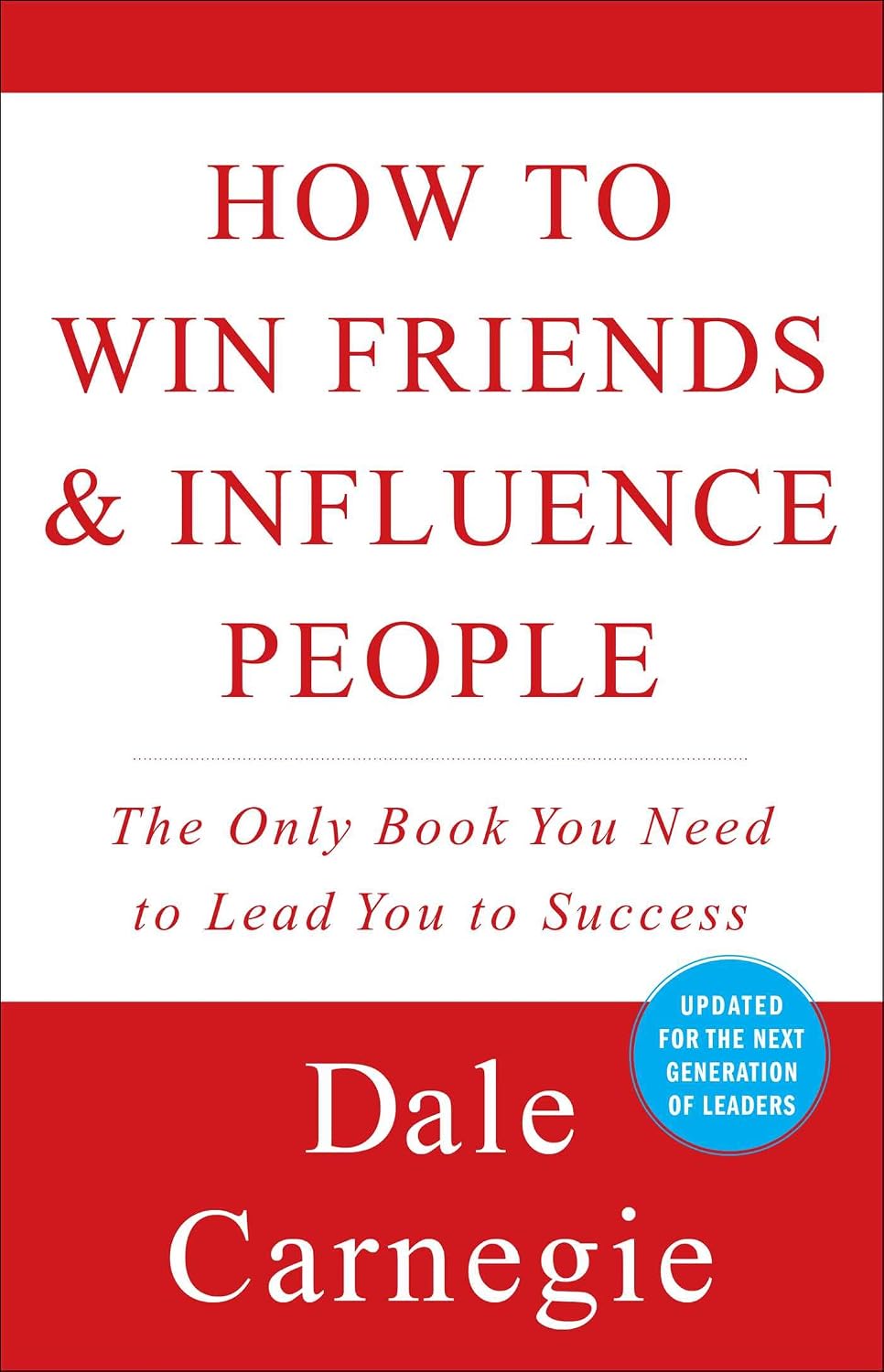
Most of us have criticized someone who deserved it, only to watch them get defensive, make excuses, or hold a grudge instead of changing. Dale Carnegie starts from that experience to argue that dealing well with people counts for more in success than technical knowledge, and that it begins with something very specific: holding back the urge to criticize, condemn, and complain. This analysis lays out his ideas to show why he argues this and how he proposes to put it into practice.
Carnegie presents the book as the product of fifteen years in what he calls a “human relations laboratory for adults,” with courses taught in New York since 1912. It matters within Eudaimanya because it helps explain a very common problem: why being right isn't enough to influence someone, and what it takes to change a reactive habit.
If you remember only one idea
According to Carnegie, criticism puts people on the defensive and doesn't change their behavior; influence starts with restraining that urge and practicing the restraint deliberately.
- People, the author says, act more from pride and emotion than from logic.
- Criticizing breeds self-justification and resentment, not correction.
- Restraining the urge takes practice, review, and revision; reading the book once isn't enough.
Audiovisual analysis
Audiovisual summary and podcast on the book’s central ideas.
Key concepts
The five ideas that hold the book together
Before the analysis proper, it helps to settle on a minimal vocabulary. These are the ideas the book returns to again and again.
Creatures of emotion
What it means: Carnegie describes people as “creatures of emotion, bristling with prejudice and motivated by pride and vanity,” not as beings who decide by logic alone.
Why it matters: It is the premise of the whole book: if others behave this way, arguing with logic isn't enough to influence them.
Human engineering
What it means: The skill of dealing with people: expressing ideas, leading, and arousing enthusiasm in others.
Why it matters: The book cites research according to which it accounts for 85% of financial success, versus 15% for technical knowledge.
Self-justification
What it means: The tendency to defend one's own behavior, even when it is deeply blameworthy, in order to keep one's self-image intact.
Why it matters: It explains why reproach strengthens the other person's defenses instead of leading them to admit fault.
Criticism as a homing pigeon
What it means: Carnegie compares criticism to a homing pigeon: it always returns to the one who sent it.
Why it matters: Criticizing damages the relationship and your own future ability to influence, even when the criticism seems justified.
A book of action
What it means: Carnegie frames the book as a manual for changing behavior, not a treatise for accumulating information.
Why it matters: It explains why he insists on practice, review, and self-examination, and not just on understanding.
Map of the book
Problem
Technical training without people skills
Common mistake
Believing criticism corrects
Thesis
Emotional people: criticism makes them defensive, not different
Framework
Rule 1 and the practices that support it
Application
Restrain the urge, review, and self-examine
Outcome
According to the author, more cooperative relationships
01 — Central thesis
Why criticism almost never works
Many people with excellent training stumble over something nobody taught them: how to deal with others when something bothers them. They react with reproach or complaint, and then they're surprised when the other person shuts down, makes excuses, or holds a grudge.
The belief Carnegie challenges is that pointing out mistakes, especially when we are right, leads people to correct themselves. He breaks with it by starting from a different picture: we are not dealing with creatures of logic but with creatures of emotion, and criticism wounds their pride and their sense of importance. To support this, he cites B. F. Skinner's experiments, which, according to the book, show that positive reinforcement produces faster and longer-lasting learning than punishment.
The author adds a weighty figure: he cites research attributed to the Carnegie Foundation and the Carnegie Institute of Technology, according to which even in engineering only 15% of financial success comes from technical knowledge and 85% from the ability to deal with people. This is a figure the book presents.
Central thesis
According to Carnegie, knowing how to deal with people counts for more than technical knowledge, and it starts with something very specific: giving up criticizing, condemning, and complaining.
The clearest example is Abraham Lincoln. After Gettysburg, General Meade let Lee's army escape, and Lincoln wrote a stern letter of reproach. He decided not to send it: according to the book, venting would only have eased his own frustration and would have destroyed Meade's future usefulness, since Meade would have had to defend himself.
02 — Main mechanism
How people react when they feel criticized
Think of the last time someone pointed out your mistake harshly. Chances are your first reaction wasn't to admit it but to explain yourself. Carnegie describes this process as a sequence: criticism puts the other person on the defensive, forces them to justify themselves, wounds their pride, and leaves a resentment that can last for years, without solving the underlying problem.
Self-justification here means that people defend their behavior to protect their self-image, even when what they did was very serious. The book illustrates this with extreme cases: “Two Gun” Crowley, who after killing a policeman wrote that he had “a weary heart, but a kind one, one that would do nobody any harm,” or Al Capone and Dutch Schultz, who, according to the book, saw themselves as public benefactors. It also records the observation of Lewis Lawes, the warden of Sing Sing: most inmates looked for reasons to justify themselves and insisted they should never have been locked up.
The following diagram summarizes the sequence Carnegie describes when someone receives criticism.
The author learned this firsthand. As a young man, Carnegie added “Dictated but not read” to a letter to the writer Richard Harding Davis, to seem very busy. Davis sent it back with a cutting remark: “Your bad manners are exceeded only by your bad manners.” Carnegie admits the slip was his own, but says that ten years later, on learning that Davis had died, the only thing he could remember was that reproach.
03 — Main components
The central rule and the practices that support it
The book develops one central rule and a set of practices to support it. The rule is the first one in Part One, “Fundamental Techniques in Handling People”: “If you want to gather honey, don't kick over the beehive,” which means don't criticize, condemn, or complain.
Restraining that urge in the heat of the moment is hard, which is why Carnegie adds “nine suggestions” for getting the most out of the book. These are the author's own; grouping them into a habit-building system is an editorial reading by Eudaimanya. To explain the book clearly, these practices can be organized into four groups.
01
Motivation
Start from a “deep, driving desire to learn” and a firm decision to get better at dealing with people. Without that commitment, the techniques turn mechanical.
02
Active reading
Read each chapter twice, stop to think about how to apply it, and mark up the text with lines, highlighting, or notes so you can consult it later.
03
Review and practice
Review the marked passages every month and apply the principles in every interaction. The book cites Bernard Shaw: what is merely taught is never learned.
04
Monitoring and recording
Agree with another person on a financial penalty for each lapse, do a weekly self-examination, and write down concrete cases of success, with names, dates, and results.
The sources give examples of two of these practices: an insurance manager who reread her contracts every month for fifteen years, and a Wall Street bank president who, every Saturday night, assessed his interviews with a self-critical questionnaire. In both cases the book does not reveal their identity.
04 — Deeper layer
Beneath the surface: pride, vanity, and self-justification
Beneath the rule lies an idea about who we are. Carnegie starts from the premise that the desire to feel important and valued drives much of what we do. He cites the psychologist Hans Selye: “As much as we crave approval, we dread condemnation.”
If that is true, criticism strikes at the most sensitive spot, and the defensive reaction stops being a character flaw and becomes, within this framework, an expected response. That is why the author doesn't ask merely for kindness: he asks us to understand the other person's reasons before judging them. He cites John Wanamaker, who, after realizing the futility of scolding others, decided to concentrate on overcoming his own limitations.
There is also a premise about learning. Citing Herbert Spencer, Carnegie argues that the great aim of education is not knowledge but action. That is why he presents his work as a “book of action,” and why, by his own account, its content comes from a fifteen-year laboratory with thousands of adult students rather than from theoretical deduction.
The book also contains a broader idea about human potential: citing William James, it claims that we are only “half awake” and use just a small part of our resources. For Carnegie, learning to deal with people is a way of tapping some of that potential.
05 — Limits and failure conditions
Where it breaks down and what it doesn't promise
The book itself names conditions for it to work, and several of them are exactly where it most easily fails.
Lack of real desire
Carnegie demands a deep desire to learn. Whoever applies the guidelines without that commitment turns them into mechanical maneuvers with no real persuasive force.
Forgetting under pressure
In a tense situation, emotional impulse overrides what is known only in theory. That is why the author recommends reviewing the book every month and practicing.
Criticizing before correcting yourself
Trying to reform others without examining your own character. The book cites Confucius: don't complain about the snow on your neighbor's roof when your own doorstep is unclean.
It is also worth reading the evidence with care. The 15% and 85%, the results reported by employers, and the testimonials from graduates are claims and accounts from the book; the sources do not verify them independently. Several cases, moreover, lack an identity: the insurance manager, the Wall Street banker, the employer of 314 workers, or the Philadelphia Gas Works employee.
Finally, the book offers no guarantee of results. It describes a demanding training, with ongoing review and self-examination, and presents its results as testimonials, not as assured outcomes.
06 — Application
How to put the framework to use
The book shifts attention from what the other person does wrong to how we react. Its central application is to restrain the urge to criticize, condemn, or complain. The author's suggestions for sustaining this can be read as a usage guide, not a closed method.
01
Notice the urge
Before criticizing, ask yourself whether you want to vent or to bring about a change. Lincoln wrote his letter to Meade and put it away unsent.
02
Understand the other person's reasons
Before judging, consider their situation. This is the attitude Lincoln took toward Meade and Wanamaker toward other people's shortcomings.
03
Practice and review
Apply the principle in real interactions and review what you have marked every month. Carnegie maintains that without practice, what you've learned is forgotten.
04
Do a weekly self-examination
Set aside a fixed time to review your decisions and mistakes of the week, like the banker who did so on Saturday nights.
05
Record concrete cases
Write down names, dates, and results for each application, rather than generalities. The book proposes this as evidence of your own progress.
What to remember
- According to Carnegie, we deal with creatures of emotion, driven by pride and vanity, not by logic alone.
- Criticism puts the other person on the defensive and leads them to justify themselves, not to admit fault.
- Rule 1 of the book is: don't criticize, don't condemn, and don't complain.
- Restraining the urge takes practice: monthly review, active learning, and self-examination.
- The figures and testimonials are claims made by the book, not evidence verified here.
What the book does not say
A simplistic reading reduces it to “be nice and everything will work out,” or to a collection of tricks for manipulating people. Carnegie argues something else: restraining criticism takes self-control, constant practice, and review, and without a genuine desire to learn, the techniques turn into mechanical maneuvers. Nor does he promise guaranteed results: the success stories are testimonials the book itself reports.
Synthesis
Influence begins with self-restraint
Carnegie proposes changing the question. Instead of “what did the other person do wrong,” he asks “how am I reacting, and what do I gain from it?” In his framework, criticism relieves the person who delivers it and rarely changes the person who receives it; influence comes from understanding the other person and training your own self-control.
That idea has a broader implication: knowing what to do is not enough. The book insists that what we learn slips away under pressure unless it is practiced and reviewed, which is why it presents the work as an ongoing effort on oneself.
What separates holding back criticism out of real understanding of the other person from doing it as a technique to get something from them?