
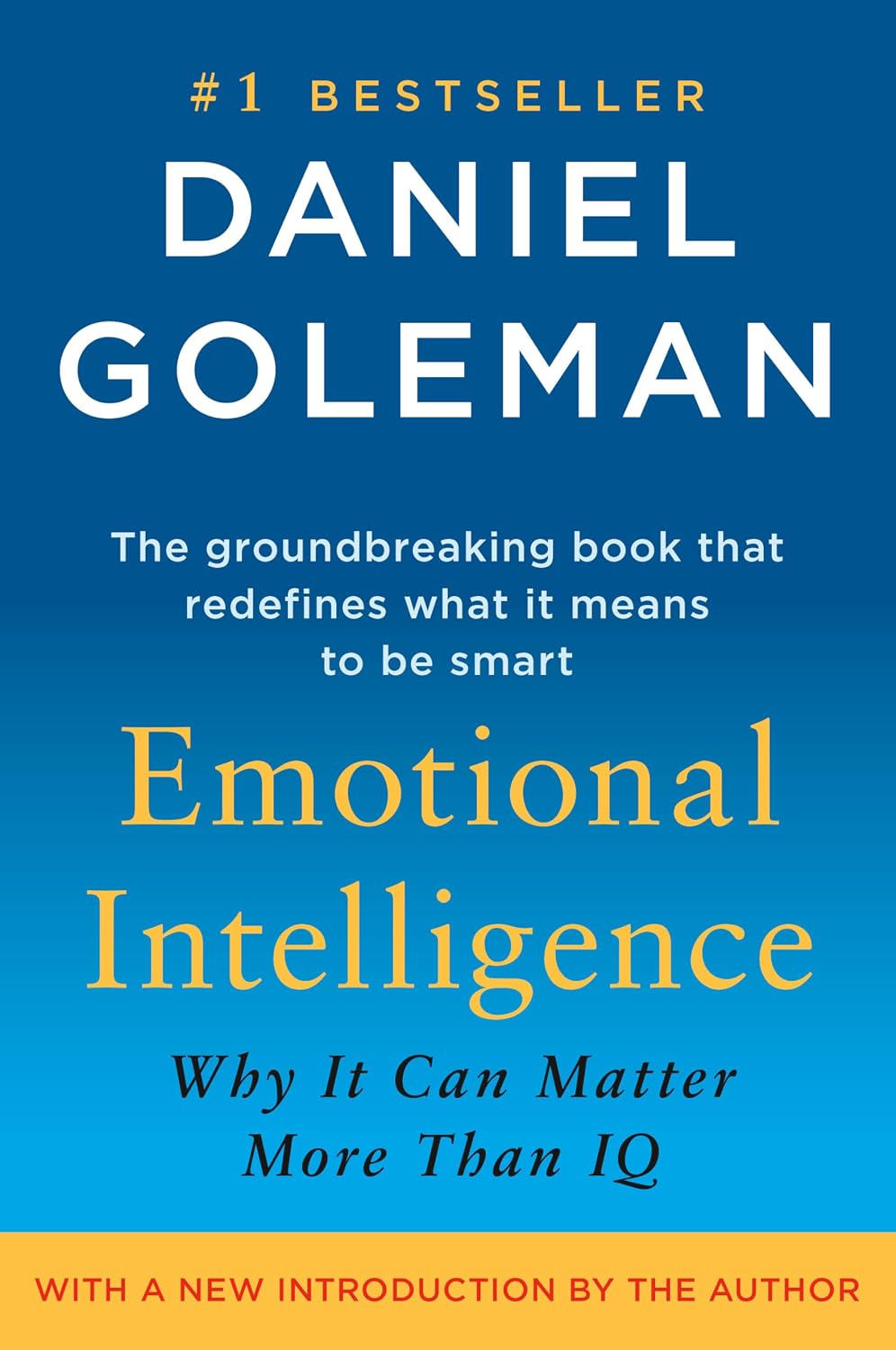
Some people have outstanding grades, impressive degrees, enviable jobs — and still ruin a dinner over a throwaway remark, or freeze up with anxiety over a minor setback. Daniel Goleman starts from that everyday contradiction to ask why being smart isn't always enough: sometimes there's plenty of intellect and a shortage of something much harder to measure.
Goleman, a psychologist and science writer, was writing at a time when IQ dominated the conversation about success. His argument draws on neuroscience, psychology, and everyday observation to explain why intellect on its own never protects anyone from their own impulses.
If you remember only one idea
The ability to recognize and manage your own emotions — and to read other people's — weighs more heavily on a person's life than their IQ.
- IQ accounts for only part of life success; the rest comes down to character and emotional self-management.
- Under intense stress, the emotional mind can take over before reason has even registered what's happening.
- This ability isn't a fixed trait: it can be taught, especially when cultivated from childhood.
Audiovisual analysis
Audiovisual summary and podcast on the book’s central ideas.
Before we begin
Six terms that will make the rest of this analysis easier to follow
Goleman blends neuroscience and psychology with a vocabulary of his own. Before getting into the analysis, it's worth pinning down these terms: they're the building blocks that later explain how emotion can help reason along — or sabotage it.
Emotional intelligence
What it means: the ability to recognize and manage your own emotions, and to recognize and respond well to other people's.
Why it matters: for Goleman, it's what turns intellect into a life that actually works, rather than potential that goes to waste.
The rational mind and the emotional mind
What it means: two ways of processing reality — one slow and reflective, the other instant and associative — coexisting in a precarious balance.
Why it matters: the book argues that reason's grip weakens the more intense the emotion in play becomes.
Amygdala hijack
What it means: the moment the amygdala seizes control of the response before the rational mind can step in.
Why it matters: it explains why perfectly reasonable people can overreact wildly under intense stress.
Self-awareness
What it means: the ability to notice a feeling as it's happening, not just after you've already acted on it.
Why it matters: Goleman treats it as the foundation the other emotional competencies rest on.
The neural back alley
What it means: a shortcut that sends the body an incomplete, blurry version of a stimulus so it can react before fully understanding it.
Why it matters: it protects against real danger, but it's also the source of snap judgments and overreactions.
Emotional plasticity
What it means: the emotional brain's capacity to change with experience, particularly during childhood and adolescence.
Why it matters: it means the temperament you're born with doesn't lock in how you handle emotions as an adult.
The book's arc
Problem
Smart people whose personal or emotional lives fall apart
Common mistake
Believing that IQ predicts success in life
Thesis
Managing emotions matters more to a life than IQ does
Framework
The five domains of emotional intelligence
Application
Noticing a feeling as it happens, without suppressing it or being swept away by it
Outcome
Character and how you relate to others shape a life as much as intellect does, if not more
01 — The limits of IQ
Why intelligence isn't enough
It's tempting to assume that top grades or a high IQ point toward a life that "goes well." Goleman challenges that with hard numbers: a long-term study of Harvard graduates found that a higher IQ predicted neither a better salary, nor a better professional standing, nor greater personal satisfaction later in life. And in the Somerville study, the same share of men — 7% — had been out of work for ten years or more among both the low-IQ and the high-IQ groups.
The break the book makes is a clear one: IQ accounts for only a fraction of life success — Goleman puts it at around a fifth — and the rest comes down to variables like character, luck, and, above all, the ability to manage your own emotions and read other people's. Emotional intelligence means exactly that here: noticing a feeling as it happens and knowing what to do with it, both in yourself and with others.
Central thesis
The ability to recognize and manage your own emotions, and to read other people's, weighs more heavily on a person's life than their IQ.
Goleman isn't arguing that one mind should replace the other, but that the two need to work in concert. The imbalance shows up when either one dominates permanently: excessive analytical coldness and excessive emotional reactivity each, in their own way, produce decisions that don't serve the life of the person making them.
02 — When emotion hijacks reason
How an amygdala hijack works
To explain why someone can "lose it" in a matter of seconds, Goleman turns to the architecture of the emotional brain. The amygdala acts as a sentinel that puts every incoming signal through a primitive question — does this hurt me, is this dangerous? — and it can trigger an emergency response before the rest of the brain has even finished processing what's going on.
An amygdala hijack happens when the short route wins out: the amygdala floods the body with alarm neurotransmitters and mobilizes it entirely before the neocortex has finished making sense of the situation. Goleman illustrates the mechanism with the case of Richard Robles, who, decades after committing a double murder in a blind fit of rage, described the moment as if his head had simply "exploded."
This isn't some isolated glitch — it's the necessary trade-off of a system built for immediate survival, not for accuracy. Understanding how the short route operates is, in Goleman's account, exactly what makes it possible to catch it firing off in yourself.
03 — The five domains of emotional intelligence
What this capacity is made of
Building on Salovey's model, Goleman organizes emotional intelligence into five domains that each build on the last. Self-awareness is the foundation: without it, the book argues, a person is a passenger to their own impulses rather than the one steering.
01
Self-awareness
Noticing a feeling as it's happening. For Goleman, it's the keystone faculty: without it, a person can't steer their own life with any real purpose.
02
Managing emotions
Matching emotional expression to the context and bouncing back from setbacks. Goleman revives Aristotle's old challenge here: "to be angry with the right person, to the right degree, at the right time... is not easy."
03
Motivating yourself
Putting emotion to work in the service of a goal, including the ability to delay gratification. It fails when anxiety or boredom sabotages performance.
04
Empathy
Reading other people's emotions through nonverbal cues. In the book's account, it's the root of altruism and of relationships that actually mean something.
05
Handling relationships
The social skill of managing other people's emotions. Goleman ties it directly to leadership and to cooperation.
04 — A biological inheritance that no longer fits
Why we're still reacting like it's the Pleistocene
Underneath the five domains lies a deeper explanation of why emotions carry so much weight: they're not some cultural add-on, but a response system forged by evolution. To make sense of that layer, it can be broken down into three related ideas — an editorial grouping, not a numbering the book itself sets out this way.
1
A system built for survival, not for precision
According to the book, every emotion is an instant action plan: fear sends blood to the legs to enable flight, anger sends it to the hands. These are useful responses when taking time to think is a luxury that could cost you your life — not when they're triggered by an annoying email.
2
The evolutionary mismatch
Goleman points out that we face distinctly modern dilemmas armed with an emotional repertoire built for Pleistocene-era survival. That outdated alarm system is, in his account, the source of much of our day-to-day overreaction.
3
A destiny that can still be rewritten
Against this biological weight, the book stresses that neuroplasticity keeps shaping the emotional brain through experience, especially during childhood and adolescence. Leaving that education to chance, Goleman argues, carries a social cost that's far from trivial.
This deeper layer doesn't compete with the five domains laid out earlier — it explains them. The fact that self-awareness or empathy can be cultivated only makes sense if the system underneath them — a malleable emotional brain, not a fixed one — allows for it.
05 — Where this framework falls short
The limits of managing your own emotions
The very mechanism that protects us can also fail, and the book doesn't hide it: the same short route that saves your life in a real emergency is the one that produces bad judgment calls when the threat isn't real.
A response that's "quick but dirty"
The thalamus-to-amygdala route works off partial, blurry information. It's built for immediate safety, not for accurate judgment, which is exactly why it produces overreactions on a regular basis.
Not a guaranteed formula for success
The book attributes the 80% of life success that IQ doesn't explain to character and luck as well, not to emotional intelligence alone. Managing emotions well helps, but it isn't the only variable at play.
Limited windows of opportunity
The emotional brain's plasticity is greatest during childhood and adolescence. Building these competencies later in life is still possible, but the book acknowledges those early windows are especially favorable.
The extreme case of affective blindness
The book documents the case of a young man whose amygdala was removed for medical reasons and who, as a result, lost all interest in other people — unable to recognize feelings even in his own parents.
These limits don't undercut the book's central argument; they mark out its edges. Emotional intelligence doesn't replace character or luck, and the same system that lets you react in time to real danger is the one that, left unchecked, can lead you to act badly.
06 — Putting this lens to work
A guide to reading your own reactions
Goleman doesn't offer a numbered method. What he offers instead is a shift in attention toward something that usually goes unnoticed: the instant a feeling starts taking over.
The first move is learning to notice a feeling as it's happening, instead of only registering it after you've already acted on it. The second is drawing a clear line between managing an emotion and suppressing it: the goal isn't to get rid of anger or fear, but to express them in proportion to the situation — exactly the challenge Aristotle already raised.
Faced with impulses that fire off before reason can step in, the book invites you to spot the moment the emotional mind has taken the wheel, so you can regain perspective without denying what you're feeling. And it's worth remembering that this ability isn't fixed: because it can be taught, lacking it isn't a life sentence — it's a gap that can be closed, especially if it's addressed early.
What to remember
- IQ accounts for only a fraction of life success.
- The emotional mind can seize control from reason in milliseconds, especially under intense stress.
- Self-awareness — noticing a feeling as it happens — is the foundation the other competencies depend on.
- Managing an emotion isn't the same as suppressing it: the goal is proportion, not elimination.
- Emotional intelligence can be taught, especially when it's cultivated from childhood.
What this book doesn't say
It's tempting to read this analysis as an excuse for acting on impulse: "it's my amygdala, I couldn't help it." Goleman says no such thing. An amygdala hijack explains why an overreaction happens, but the book presents that mechanism as exactly the kind of thing you can learn to recognize and regulate — not as an excuse. Nor does it present emotional intelligence as a guarantee of success on its own: the book itself acknowledges that character and luck also shape how a person's life turns out.
Synthesis
Bringing head and heart into balance
Emotional Intelligence isn't asking anyone to choose between thinking and feeling. It's asking us to recognize that both systems are always at play — sometimes well, sometimes badly — and that learning to notice when one has crowded out the other matters, for Goleman, just as much as any test that measures IQ.
The book leaves one question only half-answered: what it would actually take, in practice, to teach emotions as systematically as we teach arithmetic or reading.
How far can a society that still measures success by intellect go in actually teaching — rather than simply demanding — the ability to manage one's own emotions?