
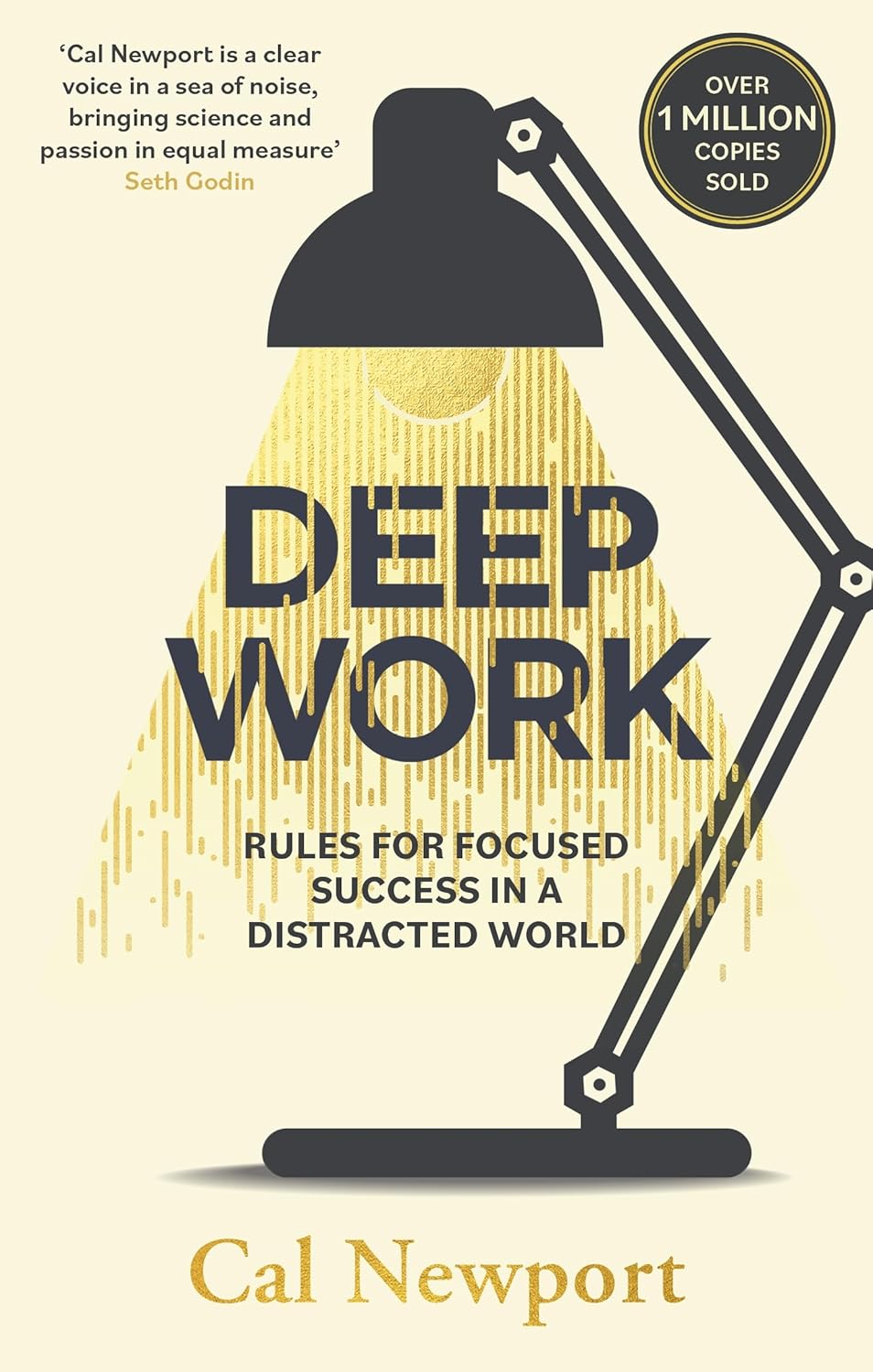
A knowledge worker ends the day having answered dozens of emails, jumped from meeting to meeting and felt permanently busy — unable to point to a single result that actually matters. Cal Newport documents why that feeling is not a personal failure, but the symptom of a capacity that the knowledge economy has allowed to atrophy precisely when it needs it most.
Newport, a computer science professor, builds the system from case studies of scientists, writers and executives who deliberately protect their capacity for concentration against a professional culture that rewards constant availability.
If you remember one idea
Distraction-free concentration has become scarce precisely when it has become most valuable — and no one measures its opportunity cost.
- Switching tasks leaves an attention residue that degrades performance on the next one, even if you don't notice it.
- Without clear metrics, organisations always default to what's easiest: responding, meeting, being available.
- Concentration doesn't appear by willpower alone; it requires rituals, boundaries and a strict selection of tools.
Audiovisual analysis
Audiovisual summary and podcast on the book’s central ideas.
Key concepts
The vocabulary that underpins the system
Before entering the framework, it's worth fixing the terms Newport uses to describe both the core mechanism and its most common failure modes.
Deep Work
What it means: professional activity performed in a state of full concentration, free from distraction, pushing the mind to its cognitive limits.
Why it matters: it is the only source of results that are genuinely hard to replicate in an economy saturated with shallow work.
Attention residue
What it means: part of the mind stays anchored to the previous task when you switch activities too quickly.
Why it matters: it explains why multitasking degrades performance even when the person doing it doesn't notice.
Scheduling philosophies
What it means: the different models — monastic, bimodal, rhythmic, journalistic — for fitting depth into a real-world schedule.
Why it matters: they make the system adaptable to any profession, not only to those who control their entire working day.
Craftsman approach to tool selection
What it means: adopt a digital tool only if its net benefit clearly outweighs its cost against your most important goals.
Why it matters: it replaces the automatic adoption of technology with a verifiable criterion.
Ego depletion
What it means: willpower operates like a finite muscle that tires with every use.
Why it matters: it reveals why intentions without systems or rituals consistently fail.
Neural myelination
What it means: the physical strengthening of brain circuits that occurs when practising with intense, isolated focus.
Why it matters: it provides a biological basis for why depth improves skills faster than scattered practice.
Book overview
Problem
Attention is fragmented by professional hyperconnectivity.
Common mistake
Confusing being busy with producing value.
Thesis
Distraction-free concentration is a scarce and valuable asset.
Framework
Four rules for working, embracing boredom, choosing tools and protecting time.
Application
Execution rituals, the craftsman approach and block scheduling.
Outcome
Production of value that is hard to replicate.
01 — The core thesis
Why busyness is no longer productivity
Most knowledge workers believe that being available — responding quickly, attending everything, accepting any interruption — is a form of dedication. Newport documents that this belief persists precisely because almost no organisation can measure the real cost of distraction or the real value of concentration.
Without that metric, companies and workers alike default to the path of least resistance: answering emails instead of planning, attending meetings instead of deciding. Newport calls this the Principle of Least Resistance, and argues that reversing it requires treating concentration as a trainable and scarce skill — not a personality trait.
Core thesis
The ability to perform deep work is becoming increasingly rare at exactly the same time it is becoming increasingly valuable in our economy.
— Cal Newport, Deep Work
The author himself built his academic career around this idea: protected blocks of writing and study treated as unmovable appointments, while most of his colleagues competed to be the first to reply to email.
02 — Attention residue
What is lost when you switch tasks
When someone jumps from an email to a report and then to a call, they tend to believe they regain full focus instantly. Newport draws on the research of Sophie Leroy to show that isn't the case: when you switch activities, part of your attention remains anchored to the previous task. He calls this Attention Residue — each change of focus exacts an invisible toll on your performance in whatever comes next.
This residue is the technical reason why multitasking is not merely less efficient: it is actively destructive to work that demands depth. The quality of high-value work depends not only on the time invested, but on the intensity of sustained focus during that time.
This is why Newport frames high-value output as the product of time invested multiplied by intensity of focus — not as a simple sum of hours in front of a screen.
03 — The four rules
The operational architecture of the system
Newport translates the thesis into four concrete rules, each targeting a different obstacle: the lack of a system for getting started, dependence on stimulation, poorly chosen technology, and the shallow work that fills the day without producing anything of worth.
01
Work deeply
Choose a scheduling philosophy — monastic, bimodal, rhythmic or journalistic — and build execution rituals that reduce the friction of starting each session.
02
Embrace boredom
Deliberately train tolerance for understimulation through scheduled disconnection blocks — like calisthenics for attentional control.
03
Quit social media
Apply the craftsman approach: keep a digital tool only if its benefit clearly outweighs its cost against the goals that truly matter.
04
Drain the shallows
Quantify shallow work using the Recent Graduate Test and prevent it from crowding out the daily capacity for concentration, which is finite by nature.
04 — Designing the environment for concentration
Depth depends on design, not character
An idea runs through the entire book without ever being named as such: concentration is not a trait some people have and others lack — it is an effect of the environment each person constructs around themselves. Whoever relies on willpower alone to concentrate is, according to Ego Depletion theory, betting on a resource that wears out like a muscle with every decision of the day.
This is why Newport documents cases where the environment does the work that willpower cannot sustain. J.K. Rowling booked a hotel suite to eliminate any possibility of interruption while finishing the last Harry Potter — a Grand Gesture that, by raising the psychological cost of abandoning the task, reinforces commitment to it. At a different scale, Bell Labs' design combined corridors that encouraged serendipitous encounters with offices that allowed total isolation: a hub-and-spoke collaboration that didn't force a choice between serendipity and depth.
Even deadlines matter: Theodore Roosevelt devoted few hours to studying at Harvard, but artificially tight deadlines — what Newport calls Roosevelt Dashes — forced an intensity of focus that no generous schedule would have produced on its own. The implication is uncomfortable for anyone seeking shortcuts: no willpower trick can substitute for an environment designed for depth.
05 — When the system fails
The limits the book itself acknowledges
The underlying obstacle is that almost no organisation measures the cost of distraction or the return on concentration. Newport calls this the Metric Black Hole, and warns that without that data, any individual attempt to protect depth will collide with a culture that continues to reward visible availability.
No metric, no change
If a company cannot quantify the cost of interruptions, any individual effort to reduce them will read as an eccentricity, not an improvement.
Doesn't apply to every role
Newport acknowledges that executives acting as rapid decision engines, or sales roles where connectivity is the core asset, benefit less from the system.
Training outside work hours
The system fails if the person trains their brain for constant distraction outside working hours, because that capacity doesn't stay neatly within one context.
Blanket rejection of technology
The book does not advocate avoiding technology on principle: rejecting a tool without applying the craftsman approach is just as arbitrary as adopting it without evaluation.
The system's most honest limit is this: it requires a degree of real autonomy over one's own schedule. Without the genuine ability to decide when and how to work, none of the four rules can be sustained for long.
06 — How to activate it
Implementation protocol
Newport doesn't offer a single magic step, but a sequence of mutually reinforcing decisions.
01
Choose a scheduling philosophy
Decide whether depth is organised in daily rhythmic blocks, full bimodal days or on-the-fly journalistic sessions — based on how much real control you have over your schedule.
02
Build an execution ritual
Fix the location, duration and supporting conditions for each concentration session, so that starting no longer requires a conscious decision every time.
03
Schedule disconnection blocks
Reserve fixed periods without internet to train resistance to the pull of novelty, treating each block as a session of mental calisthenics.
04
Apply the craftsman approach to every tool
Evaluate each app or social network by its net impact on your most important goals, not by the marginal benefits it offers.
05
Close the day with an explicit ritual
Log pending tasks and verbally mark the end of the working day to free your mind from ruminating on unfinished business.
What to remember
- Distraction-free concentration is scarce because almost no one measures its opportunity cost.
- Every task switch leaves an attention residue that degrades subsequent performance, even if you don't notice it.
- Willpower depletes like a muscle: rituals and environmental design replace the need for raw discipline.
- Not every technology deserves to be rejected or adopted equally: the criterion is its net impact on what genuinely matters.
- The system requires some real autonomy over your own schedule; not every role can apply it in the same way.
What this book does not say
Deep Work is not a manifesto against technology, nor a productivity manual built around to-do lists. Newport doesn't ask you to eliminate email or social media on principle — he asks you to subject every tool to an explicit assessment of its net benefit. Nor does he present the system as universal: he acknowledges that executives and commercial roles whose value depends on constant availability get less out of these rules than a researcher or a writer does.
Synthesis
Producing what cannot be improvised
Newport's thesis, restated plainly: in an economy that rewards constant availability, whoever deliberately reclaims the capacity to concentrate without distraction produces something almost no one else can replicate. It isn't about working more hours — it's about protecting with explicit rituals and criteria the few hours in which thinking genuinely performs.
The shift in perspective the book proposes is not technological but a matter of priority: stop measuring the day by how much was responded to, and start measuring it by how much was produced in genuine concentration.
If depth requires withdrawal and constant connectivity is what today's economy rewards socially, are you willing to appear less available in order to produce more of what actually matters?