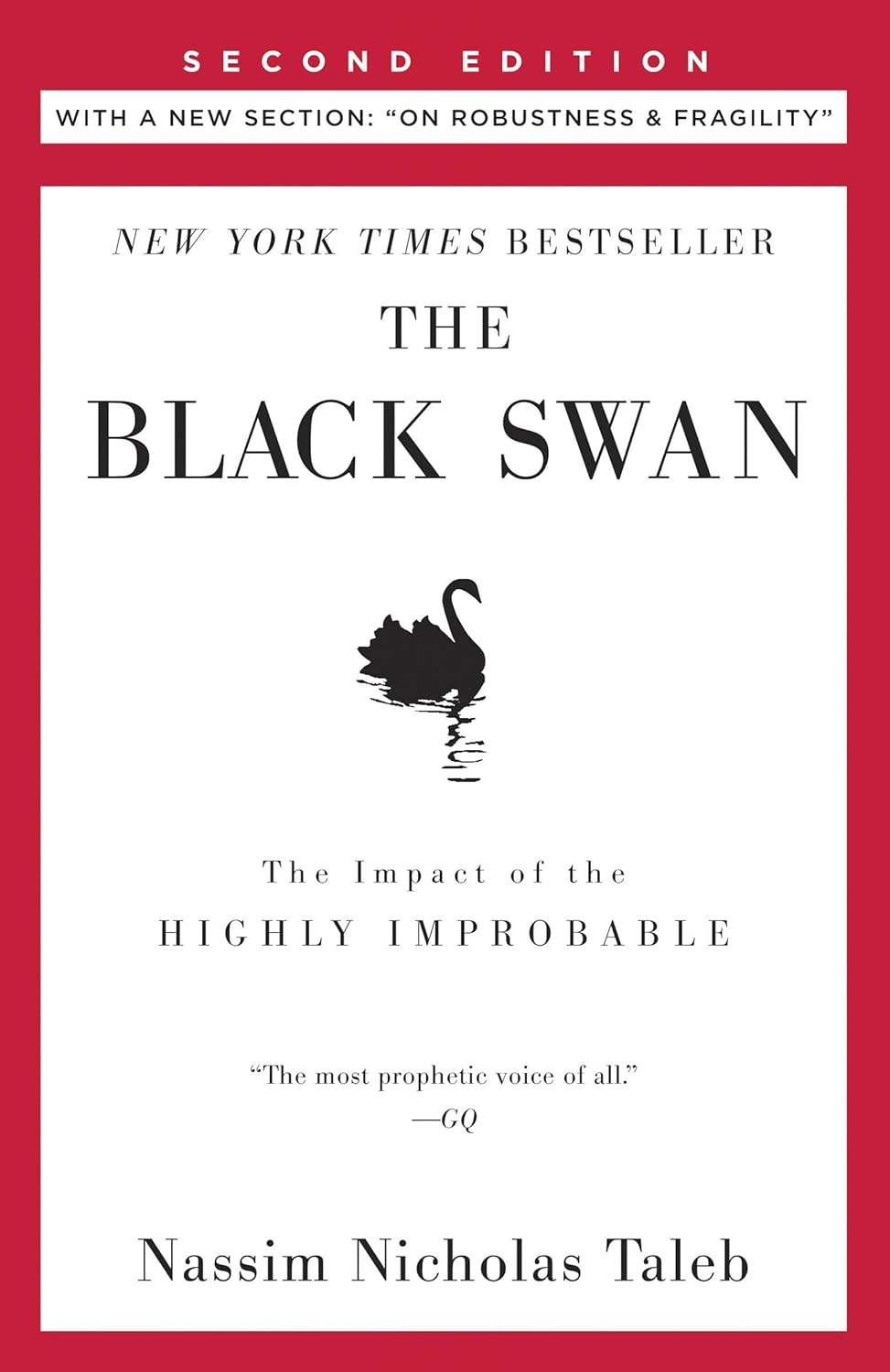
Someone builds an entire life — savings, career, decisions — assuming the future will look like the recent past. Every day nothing extraordinary happens, they read that calm as proof their way of thinking is correct. It isn't: the event that will disprove all of it simply hasn't arrived yet. Nassim Nicholas Taleb didn't write a book about one-off bad luck. He wrote about what it means to build an entire life with no margin for what can't be foreseen.
The system starts from an uncomfortable observation about how we mistake the map for the territory: we apply models built for a predictable world to a world where a single extreme event can outweigh every data point that came before it. Taleb, an essayist and former financial risk trader, argues for abandoning prediction and turning to preparation instead.
If you only remember one thing
What we don't know matters far more than what we do. Building a robust life doesn't mean predicting the next Black Swan — it means preparing so that, when it arrives, it works in your favor.
- The past only looks predictable after it's happened; beforehand, no one saw it coming.
- A single event can outweigh years of accumulated data.
- Knowing what's false protects you more than believing you know what's true.
Audiovisual analysis
Audiovisual summary and podcast on the book’s central ideas.
Before we begin
The concepts you need to understand the system
The rest of this analysis takes seven ideas as already understood. Laying them out here means we won't have to define them again in every section.
Black Swan
What it means: an extremely unlikely event with massive impact that only looks explainable after the fact.
Why it matters: events like these, not averages, are what actually determine outcomes in the areas that matter most.
Mediocristan and Extremistan
What it means: in Mediocristan (weight, height), averages rule and outliers don't move the total; in Extremistan (finance, fame), a single outlier can dominate everything.
Why it matters: applying Mediocristan's tools to an Extremistan world is the root error behind much of modern forecasting.
The narrative fallacy
What it means: the brain's tendency to build causal stories around facts that were actually random.
Why it matters: that story creates a false sense of understanding that gets in the way of preparing for something different.
Silent evidence bias
What it means: focusing only on those who succeeded with a given strategy, while ignoring the graveyard of everyone who tried the same thing and failed.
Why it matters: it artificially inflates confidence in strategies that actually owed much of their success to luck.
The Barbell Strategy
What it means: pairing a hyper-conservative posture across most of your resources with a small, hyper-aggressive exposure to bets with potentially unlimited upside.
Why it matters: it avoids the middle ground, where you're exposed to frequent losses while never capturing the extreme gain.
Negative empiricism
What it means: it's more reliable to know what's false (disconfirmation) than to try to confirm what's true.
Why it matters: it directs action toward eliminating known catastrophic risks instead of chasing impossible certainties.
The antilibrary
What it means: treating what you don't know as an active tool for inquiry, not something shameful to hide.
Why it matters: it keeps the epistemic humility needed to stay open to the unexpected instead of closing your eyes to it.
The shape of the book
Problem
Lives built with no margin for the unforeseeable.
Common mistake
Believing more data and experts improve prediction.
Thesis
What we don't know matters more than what we do.
Framework
Skeptical Empiricism.
Application
Cut negative exposure, maximize serendipity.
Payoff
A life that survives, and benefits from, the unexpected.
01 — The central thesis
Why what we don't know outweighs what we do
The common intuition is that the more historical data and experts we consult, the better we'll be able to predict the future and control risk. Taleb shows that in the areas where it actually matters — finance, history, technology — this intuition fails systematically: a single extreme event outweighs every piece of data accumulated before it, and no expert saw it coming.
This isn't an occasional failure of prediction — it's a structural feature of the kind of world we operate in. The more certain someone feels about understanding the world, the more exposed they are to being wrecked by an unlikely event, because that confidence pushes them to bet harder exactly where they have the least control.
Central thesis
What we don't know matters far more than what we do, and building a robust life means giving up on predicting the next Black Swan and instead preparing so that, when it arrives, it works in our favor.
The practical takeaway isn't pessimism or paralysis — it's designing decisions and structures where not knowing isn't a liability, but a source of competitive advantage.
02 — The central mechanism
How the past deceives us about the future
Taleb describes a mental sequence that repeats every time we interpret a past event, and it explains why we feel confident right before what we never anticipated finally arrives.
Step 1
An event happens
Real randomness
The event unfolds with no clear pattern, shaped by countless unpredictable factors.
Step 2
A story gets built
The narrative fallacy
The brain imposes causal links onto the random event so it can be stored and remembered.
Step 3
A sense of understanding
Retrospective distortion
The past starts to look obvious and predictable, even though no one predicted it at the time.
Step 4
False certainty
Epistemic arrogance
That illusory understanding feeds confidence in models that will fail at the next extreme event.
Extended calm doesn't break this cycle — it's just a temporary absence of evidence to the contrary, and it's easily mistaken for real security.
03 — The system's components
The system's four pillars
Taleb organizes Skeptical Empiricism into four analytical pieces that work together.
01
Mediocristan vs. Extremistan
Classifies phenomena by their scalability: in Mediocristan, outliers don't determine the outcome; in Extremistan, a single rare event dominates the entire result.
02
The Triad of Opacity
Decodes three historical biases: the illusion of understanding, retrospective distortion, and experts' overvaluation of factual information.
03
Cognitive fallacies
Identifies the narrative fallacy, confirmation bias, and the ludic fallacy: mistaking real uncertainty for the closed rules of a game of chance.
04
The Barbell Strategy
Pairs a hyper-conservative approach to protecting assets with a hyper-aggressive exposure to positive Black Swans.
04 — The deep layer
How real protection gets structured
Underneath the taxonomy and the biases sits a set of operating principles that determine whether someone can turn uncertainty into an advantage instead of a threat.
1
Asymmetric outcomes
The ability to structure your life or your business so that not knowing isn't a liability but a competitive edge: protect ruthlessly where the worst-case scenario is unacceptable, and expose yourself freely where the loss is capped and the upside is open.
2
Negative empiricism
It's more reliable and more powerful to know what's false than to try to confirm what's true. This epistemic asymmetry directs action toward eliminating identifiable catastrophic risks, rather than chasing certainties that will never arrive.
3
The Antilibrary
Treating what you don't know as a tool for active inquiry, not a flaw to cover up. The unknown isn't a gap to fill in — it's territory you need to learn to inhabit.
These three principles share the same underlying move: none of them tries to reduce the world's actual uncertainty. All three try to change the position from which you face it.
05 — Points of friction
The errors that false certainty produces
The system has predictable points of failure, nearly all tied to overestimating what you actually know.
Epistemic arrogance
The failure of overestimating what you know and underestimating real uncertainty, artificially compressing the range of possible outcomes.
The tunneling effect
The tendency to focus only on already-known sources of uncertainty, ignoring the "unknown unknowns" that actually shape the system.
Domain dependence
The inability to carry critical reasoning from one field — science, say — over into another, such as finance or personal life.
The Great Bell Curve Fraud
Using Gaussian statistics in the social sciences, which Taleb calls a great intellectual fraud for its blindness to sudden jumps.
The system itself owns up to an honest operational gap: it describes with precision how to protect yourself from randomness and benefit from it, but it doesn't resolve the psychological cost of absorbing small, constant losses before the massive event arrives that finally justifies them.
06 — Implementation protocol
How to put the system into action
Applying the system reorganizes everyday life around two extremes — extreme protection and extreme openness to opportunity — while avoiding the middle ground where most people live exposed without knowing it.
01
Identify your exposure
Work out which areas of your life carry exposure to a negative Black Swan — a loss no low probability can compensate for.
02
Cut the incalculable risk
Exit that exposure without negotiating, whatever the apparent cost, whenever the worst-case scenario is unacceptable.
03
Maximize serendipity
Set aside a small share of time, money, or attention for capped-loss, potentially enormous-gain bets: projects, contacts, ideas that seem irrelevant today.
04
Distrust easy explanations
Stay systematically skeptical of stories that make the past sound like it was obvious all along.
05
Calibrate by impact, not probability
Replace the question "what's going to happen?" with "what impact would it have if it did?" — impact is knowable; probability almost never is.
What to remember
- The past only looks predictable after it's happened; beforehand, no one saw it coming.
- A single event can outweigh years of accumulated data.
- Knowing what's false protects you more than believing you know what's true.
- Extended calm isn't proof of safety — it's just a temporary absence of evidence.
- Protecting yourself from disaster and chasing a lucky break can coexist in the very same decision.
What this book doesn't say
It's easy to read The Black Swan as an ordinary financial risk-management manual, but the system operates across any scalable domain — ideas, networks, career — not just investment portfolios. Nor does it boil down to "you should stay optimistic in the face of uncertainty": the book isn't about attitude, it's about structure. It isn't a method for predicting crises or getting ahead of the next catastrophe: Taleb is explicit that the unknown is unknowable, and the system doesn't offer foresight — it calls for preparation instead. And the Barbell Strategy isn't just "diversify your portfolio": it's a whole-life posture that pairs extreme protection with extreme openness to opportunity.
Synthesis
Preparing matters more than predicting
The Black Swan doesn't propose anticipating the next extreme event — it proposes no longer needing to. What you don't know outweighs what you do, and building for that gap is the only real protection against a world that a single day can rewrite completely.
That demands giving up the comfort of feeling certain. The confidence that comes from "understanding" the world rarely protects you from real risk — more often, it hides that risk, pushing you to bet harder exactly where you have the least control.
How many of the decisions that make you feel secure today actually depend on the next extreme event simply not having arrived yet?