
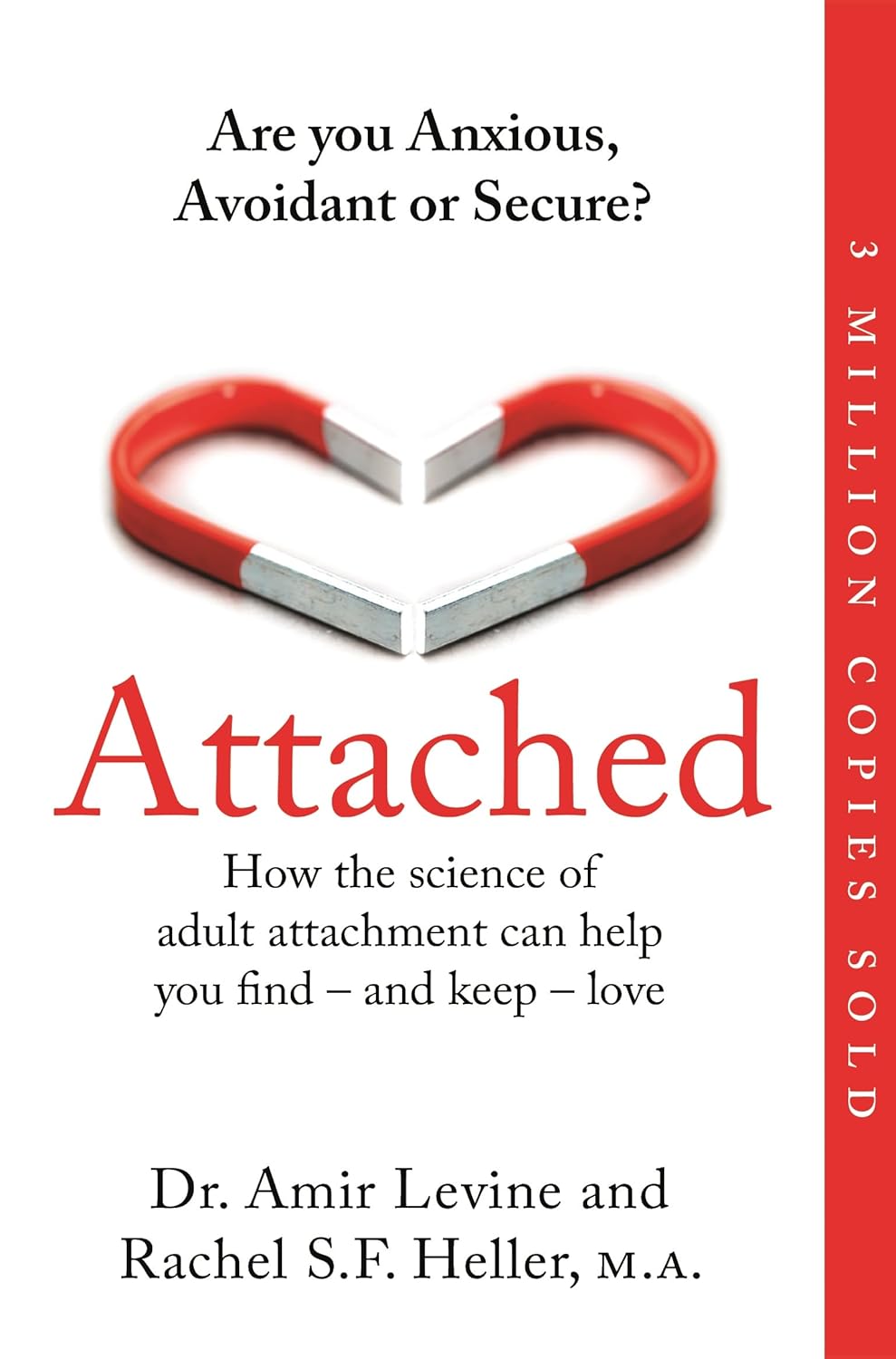
Someone has spent months trying to need their partner "less" — fewer calls, less desire to be close, less worry about what they think. They have been taught that this need for closeness is a weakness they should resolve on their own. The harder they try to need less, the worse things go with the other person. Amir Levine and Rachel Heller, a psychiatrist and a researcher, explain why that logic is inverted from the start.
The book translates decades of research in neuroscience and evolutionary biology on infant attachment into the terrain of adult romantic relationships. Its starting point is clinical, not motivational: to classify observable behavioral patterns that predict, with considerable accuracy, how someone will behave in a close relationship.
If you remember only one idea
You do not become stronger by needing others less — you become stronger by having someone safe to lean on.
- Depending on your partner is not weakness: it is a biological need, not a choice.
- Most couple arguments are really disguised requests for security.
- There are early signs that someone cannot commit — and they are almost always ignored.
Audiovisual analysis
Audiovisual summary and podcast on the book’s central ideas.
Key concepts
The vocabulary of adult attachment
Before entering the system it is worth fixing the terms the book uses to describe something almost all of us have lived through without knowing what to call it.
Attachment system
What it means: the biological mechanism that monitors and regulates closeness with the people who matter to us, like an emotional thermostat.
Why it matters: it explains why we react with alarm — not "attitude" — when we feel a bond is at risk.
Anxious attachment style
What it means: a tendency to become activated at the slightest signal of distance, seeking closeness through obsessive thoughts or demands.
Why it matters: it helps distinguish activated anxiety from intense love — something that is often confused.
Avoidant attachment style
What it means: a tendency to suppress intimacy and maintain distance when closeness begins to feel like a threat to autonomy.
Why it matters: it explains why someone can pull away precisely when the relationship is going well.
Protest behavior
What it means: demands, persistent calls or hostility seeking to restore contact when a threat to the bond is detected.
Why it matters: it reveals that many "deep" arguments are really unresolved security questions.
Telltale sign
What it means: early and undeniable signals that someone cannot offer real commitment or intimacy.
Why it matters: they are usually dismissed by optimism, at an emotional cost that grows over time.
Secure base
What it means: the set of supportive behaviors — being available, not interfering, encouraging — that make a partner function as a stable refuge.
Why it matters: it is the condition that, paradoxically, allows both people to become more autonomous on their own.
Book map
Problem
Believing that needing a partner less is a sign of emotional health.
Common error
Interpreting anxiety and drama as passion, and ignoring early telltale signs.
Thesis
Secure dependency is the foundation of real autonomy, not its enemy.
Framework
Secure, anxious and avoidant styles — activation and deactivation of the attachment system.
Application
Diagnose your own style, read protests as security requests, communicate directly.
Result
Earned security: a bond that functions as both refuge and springboard.
01 — Central thesis
The paradox of dependency
Contemporary culture repeats an idea that sounds like wisdom: that emotional health consists in not needing anyone, and that depending on another person is codependency or weakness of character. Under that logic, many people actively work to need their partner less — fewer calls, less worry, less closeness — convinced that this makes them stronger.
Levine and Heller document exactly the opposite. Dependency is not a cultural preference or a personality flaw: it is an inevitable biological fact, as real as the need to eat or sleep. No one becomes bold and independent in the world by isolating themselves emotionally; they become that way by having someone safe to depend on. The more one fights against that biology, the worse the relationship functions — not because the person is doing something wrong, but because they are rowing against their own nervous system.
Central thesis
You do not become stronger by needing others less — you become stronger by having someone safe to lean on.
This explains a pattern many people recognize without knowing what to call it: advice like "give them space" or "stop being so needy" does not resolve the insecurity in a relationship — it often worsens it, because it attacks the symptom rather than the cause.
02 — Central mechanism
The emotional security thermostat
Behind almost any couple argument about money, household tasks or weekend plans there is usually something simpler and more biological: an unspoken question about whether you can count on the other person. The attachment system here means the mechanism that constantly monitors that closeness — just as a thermostat monitors temperature — and reacts as soon as it detects the bond is at risk.
When that system detects a threat, two opposite pathways are activated depending on each person's style. Someone with an anxious style develops activating strategies: obsessive thoughts, idealization, urgent need for contact — their system shouts to restore closeness. Someone with an avoidant style does the opposite: they engage deactivating strategies, focusing on the other's flaws or pulling away, to restore a sense of space. Neither reaction is a conscious plan; both are automatic responses of the same thermostat, calibrated differently in each person.
The problem appears when two incompatible thermostats meet: one person's pursuit of closeness triggers the other's need for distance, and that distance triggers even more pursuit of closeness. It is a self-reinforcing cycle that no one designs on purpose.
03 — System components
The four pillars of the system
From that mechanism, the book proposes four operational tools for working with it rather than against it.
01
Relational DNA diagnosis
Identifying your own attachment style and the other person's by observing how each responds to intimacy and how much the bond concerns them. This is the starting point for everything else.
02
Mapping the anxious-avoidant trap
Recognizing the feedback loop between a style that seeks closeness and one that seeks distance, to stop experiencing it as a character flaw and see it as an identifiable pattern.
03
Effective communication protocol
Expressing needs and feelings directly and without blame, as a tool to check whether the other person can and will respond — and to filter quickly when they cannot.
04
Managing the secure base
Offering accessibility, not interfering with the other's autonomy and actively encouraging — so that the relationship functions as a mutual physiological regulator, not a constant source of alarm.
04 — Deep layer
Why closeness frightens some people
There is a more uncomfortable layer beneath the avoidant style, and the book does not soften it: the closer an avoidant person feels to their partner, the more threatened they perceive their own sense of autonomy — and that threat can translate into treating the person who has come closest worse than a stranger. It is not that avoidant people do not feel attachment; it is that their system interprets increased closeness as a loss of independence, and reacts by pulling away precisely when, apparently, everything was going well.
Here a particularly revealing mechanism appears: idealizing an ex-partner while in a current relationship. Far from being innocent nostalgia, it can function as a deactivating strategy — a way to keep the mind occupied elsewhere so as not to have to confront present intimacy. The book also documents the extreme case of this dynamic: the hostile inner circle, where the current partner receives systematically worse treatment than people outside the relationship, precisely because they are the one closest.
Understanding this layer changes how distancing is interpreted: not as proof that "something is wrong" with the relationship, but as the predictable response of a system that confuses closeness with loss of freedom.
05 — Friction and limits
When the system cannot save the relationship
The book itself is honest about the conditions under which this framework stops being useful, and about the errors it generates when applied incorrectly.
Confusing anxiety with passion
The emotional rollercoaster produced by an activated attachment system feels intense, but it is biological alarm — not a sign that the bond is especially valuable.
The codependency myth
Treating every need for closeness as an individual problem to fix ignores that interdependence is biological, not a debatable cultural preference.
Absolute refusal to change
The system requires both people to have, or be willing to build, a functional model of security. If one person refuses entirely, the framework has no way to intervene.
Consolidated hostile inner circle
When the avoidant dynamic has evolved into systematically hostile treatment of the partner, conflict resolution becomes nearly impossible: closeness is precisely what the avoidant rejects.
The limit is honest: this framework predicts and explains patterns, but it does not replace each person's will to change. It is highly effective for someone insecure to acquire more secure traits through sustained contact with a secure partner — but it cannot force that openness if it does not exist.
06 — Application
How to apply the diagnosis and protocol
Applying this system does not require changing partners or personality: it requires learning to read the right signals and respond to what is really being asked.
01
Diagnose your own relational DNA
Observe how you react to intimacy and how much the bond concerns you — in yourself and in the other person — before attempting to resolve any conflict.
02
Read arguments as protest behaviors
Before discussing the apparent issue — money, chores, plans — ask yourself whether the dispute is really an unspoken security request.
03
Practice direct communication
Express needs concretely and without blame, rather than waiting for the other person to guess them or resorting to hints.
04
Do not ignore telltale signs
Take seriously early signals that someone cannot offer commitment, rather than dismissing them out of optimism or initial attraction.
05
Build and offer a secure base
Be available, do not interfere with the other's autonomy and actively encourage — the condition that allows both to become more independent, not less.
What to remember
- Depending on your partner is not weakness: it is biology, not a choice.
- Most everyday arguments are disguised security requests.
- Feeling intense anxiety about someone is not the same as feeling intense love.
- Early signs of lack of commitment almost never lie — they are just ignored.
- A shared secure base is what makes real autonomy possible.
What the book does not say
It is easy to read this system as an excuse for total fusion or for giving up one's own life "for love" — but the book does not advocate that. The dependency it speaks of is secure and functional: it involves mutual accessibility and support, not canceling the other's autonomy or giving up your own life. Nor does it offer attachment styles as a fixed excuse ("I am just like this, I cannot change"): the book explicitly documents that insecure people can acquire security through sustained contact with secure partners. It is not a permanent diagnosis — it is a starting point.
Synthesis
Depending well to let go well
This book does not ask you to choose between independence and dependency, because it argues that the choice was poorly framed from the start. Real autonomy does not come from needing others less, but from having someone safe who responds when needed — the rest of personal boldness is built on that foundation, not in spite of it.
That changes the question many people ask about their relationships: not "why do I need this person so much?", but "can this person offer me the security my attachment system needs to function well?"
If much of what we call "it wasn't the right person" is really an incompatibility of biological attachment systems that could already be detected in the early signs, how much suffering in relationships is, at root, time spent ignoring information we already had?