
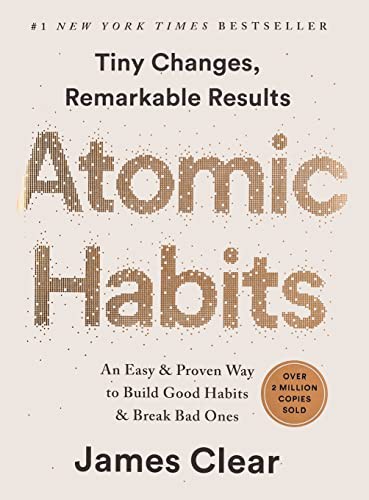
Most people know exactly what they should change in their lives. The problem isn't knowledge or initial motivation — it's that the effort collapses right before the change becomes visible. James Clear didn't write a book about discipline. He wrote about why the environment around a behavior outweighs the desire to change it.
The system grew out of an uncomfortable observation: winners and losers tend to want the same things. If ambition doesn't explain the gap between them, something else must — and that something is the system each person runs once the initial motivation is gone.
If you only remember one thing
You do not rise to the level of your goals; you fall to the level of your systems. Every habit is a vote for the kind of person you're becoming, not a step toward some external outcome.
- What separates success from failure isn't the goal — it's the system.
- Change is cumulative, not linear, which is why people quit right before it becomes visible.
- Identity doesn't come before habits; it's built by them, one vote at a time.
Audiovisual analysis
Audiovisual summary and podcast on the book’s central ideas.
Before we begin
What you need to know before diving in
The analysis that follows takes seven ideas as given. Laying them out here means we won't have to define them again in every section.
Atomic habit
What it means: a unit of behavior so small it's almost impossible to break down further, yet part of a much larger system.
Why it matters: smallness isn't a watered-down version of change — it's actually where change gets its compounding power.
Systems over goals
What it means: a goal is a one-time result; a system is the process you repeat to produce that result.
Why it matters: winners and losers share the same goals — only the system explains who actually gets ahead.
Identity-based habits
What it means: every repeated action works as a vote confirming a certain kind of person, not just another step toward a goal.
Why it matters: a habit that clashes with your self-image doesn't survive once motivation runs out.
The cue-craving-response-reward loop
What it means: the four-step neurological sequence the brain uses to turn any behavior into something automatic.
Why it matters: each of the four laws of change targets a different step in this loop.
The four laws
What it means: make the cue obvious, the response attractive, the action easy, and the reward satisfying.
Why it matters: these are the concrete levers for building a new habit or taking apart one you don't want.
The Plateau of Latent Potential
What it means: the stretch where effort is already piling up, but the results still aren't visible.
Why it matters: this is exactly where most people give up — right before the change would have shown itself.
Habit Stacking
What it means: pinning a new habit onto one you already have, instead of relying on remembering it on its own.
Why it matters: it does away with the "when do I start" question — the exact spot where most habits fall apart.
The shape of the book
Problem
Change breaks down before it ever becomes visible.
Common mistake
Chasing goals and counting on motivation.
Thesis
The system decides the outcome, not the goal.
Framework
The Four Laws of Behavior Change.
Application
Obvious, attractive, easy, satisfying.
Payoff
Not a goal checked off, but an identity taking shape.
01 — The central thesis
Why goals aren't enough
Almost everyone already knows what they'd like to change: eat better, save money, write, work out. The sticking point usually isn't a fuzzy goal — it's that the effort runs dry before it produces anything visible. When that happens, the go-to explanation is "I didn't have enough discipline," and that's exactly where the cycle starts over: same goal, same outcome.
James Clear points to something uncomfortable: winners and losers almost always share the same goals. Every marathoner wants to cross the finish line; every candidate for a promotion wants it just as badly as their peers. If the goal were what decided things, there shouldn't be any gap between them. That gap comes from somewhere else — the system each person quietly runs, day after day, long after the initial motivation is gone.
Central thesis
You do not rise to the level of your goals. You fall to the level of your systems.
— James Clear, Atomic Habits
That doesn't mean goals are useless — just that they're not enough on their own. They set the direction, but they don't generate the progress. Progress comes from the process that keeps repeating, goal in sight or not, until that process becomes who the person is.
02 — The central mechanism
The loop that builds every habit
Before redesigning any system, it helps to understand how the brain builds a habit in the first place, good or bad. Clear lays out a four-step cycle that repeats in every automated behavior, from checking your phone to going for a run.
Step 1
Cue
Trigger function
A piece of information in the environment signals a reward is coming and gets the brain ready to act.
Step 2
Craving
Motivational function
The urge to shift your internal state is what actually gets the action going.
Step 3
Response
Executive function
The behavior itself, shaped by however much friction and ability are available at that moment.
Step 4
Reward
Validation function
Satisfies the craving and tells the brain which action is worth doing again.
Each of the four laws of behavior change works on a different step in this loop: the cue becomes obvious, the craving becomes attractive, the response becomes easy, the reward becomes satisfying. That's the bridge between understanding the mechanism and actually being able to act on it.
03 — The system's components
The four laws of behavior change
Building on that loop, Clear lays out four practical laws. Installing a habit means applying them; breaking one means running them in reverse.
01
Make it obvious
Redesign your surroundings so the cue is right in front of you, and use implementation intentions along the lines of "I will do X at Y in Z."
02
Make it attractive
Build up the anticipation of the reward — for instance, by pairing a desired action with a necessary one through temptation bundling.
03
Make it easy
Strip away the friction between you and the behavior you want; the two-minute rule turns any habit into its smallest possible starting version.
04
Make it satisfying
Attach an immediate payoff to systems with a slow return, and make progress visible through habit tracking.
04 — The deep layer
The layer that makes change stick
The four laws explain how to install a habit — not why some habits hold and others fall apart the moment motivation dries up. Clear finds the answer in three layers of increasing depth.
1
Outcomes
What someone actually gets: dropping weight, publishing a book, winning a tournament. It's the most visible layer, and also the most fragile — once the outcome is reached, or stops being chased, the behavior behind it loses its reason to exist.
2
Processes
The habits and systems someone actually runs. This is where the cue-craving-response-reward loop lives, and where the four laws come into play. It holds up better than the outcome layer, but on its own it's still not quite enough.
3
Identity
The belief about who someone is. When a habit lines up with how a person sees themselves, it doesn't need outside motivation to keep going — it becomes an expression of identity rather than a means to an end.
"The goal is not to read a book, the goal is to become a reader." — James Clear
Working from the identity layer changes the starting question entirely: not "what do I want to achieve?" but "what type of person do I want to become, and what would prove that I've become one?" Every repeated habit is a vote in that direction.
This same layer also explains the system's limit: if the behavior someone wants clashes with the identity they hold onto, no amount of redesigning the environment will keep it standing forever.
05 — Points of friction
Why people quit right before the payoff
Most attempts at change don't fail for lack of a system — they fail because people don't understand how a system behaves while it still isn't producing anything visible.
The Plateau of Latent Potential
Change is cumulative, not linear: invisible work piles up until it crosses a threshold all at once, the way an ice cube stays solid right up until it hits zero degrees.
An environment left as-is
Planning a change without touching the cues around you sets motivation up to fight physical friction — and friction almost always wins.
Identity conflict
A habit that clashes with how someone sees themselves works fine as long as motivation holds, then fades the moment it doesn't.
Premature expectations
Expecting a brand-new habit to perform like a well-established one creates friction at its most fragile stage, before it's had time to automate.
The book itself is honest about this limit: even a well-designed system can look like it's doing nothing for weeks, and there's no way to know, from inside the plateau, whether the threshold is close or still far off.
06 — Implementation protocol
How to put the system to work
Applying the system doesn't start with a list of new behaviors — it starts with defining the identity those behaviors are meant to prove.
01
Define the identity you're after
Before picking a habit, answer what kind of person you want to be. Every habit that follows will be framed as evidence of that identity.
02
Make it obvious
Redesign the environment so the cue is right there without effort, and anchor the new habit to an existing one through Habit Stacking.
03
Make it attractive
Boost the appeal of the behavior by pairing it with something you already want to do.
04
Make it easy
Shrink the initial size of the task using the two-minute rule: the point is to start, not to perform.
05
Make it satisfying
Add an immediate, visible payoff — a habit tracker, an accountability partner — to carry the behavior through the plateau.
06
Audit the system regularly
Review it on a regular basis to catch the mistakes automation stops noticing, and avoid falling into the complacency trap.
What to remember
- Winners and losers usually share the same goals; the system is what tells them apart.
- Change is cumulative, not linear: people quit right before it would have become visible.
- Every habit is a vote for the kind of person you're building, not a step toward an outcome.
- The four laws act on the loop's four steps: cue, craving, response, and reward.
- Automating a habit doesn't guarantee mastery — that takes review and deliberate practice.
What this book doesn't say
It's easy to read Atomic Habits as a productivity manual built around squeezing more out of your time, but the framework applies to any area of human behavior, not just professional performance. Nor is it a foolproof method — the book itself points to explicit conditions where it fails, like identity conflicts or the complacency trap that sets in once a habit has automated. And "1% better every day" isn't meant as a literal math formula — it's a metaphor for compound interest applied to behavior.
Synthesis
The system around you decides who you become
Atomic Habits isn't a call for more discipline — it's a call for needing less of it. When the environment is set up so the right behavior is also the easiest one, motivation stops being the scarce resource everything else hinges on.
And the takeaway is an uncomfortable one: every habit you have right now, no matter how small it looks, is already casting a vote for a certain kind of person. The question isn't how badly you want the change — it's what environment you've built around it, or left unbuilt.
If identity is built from the actions you repeat, how many of your current habits did you actually choose — and how many were chosen by an environment you never designed?