
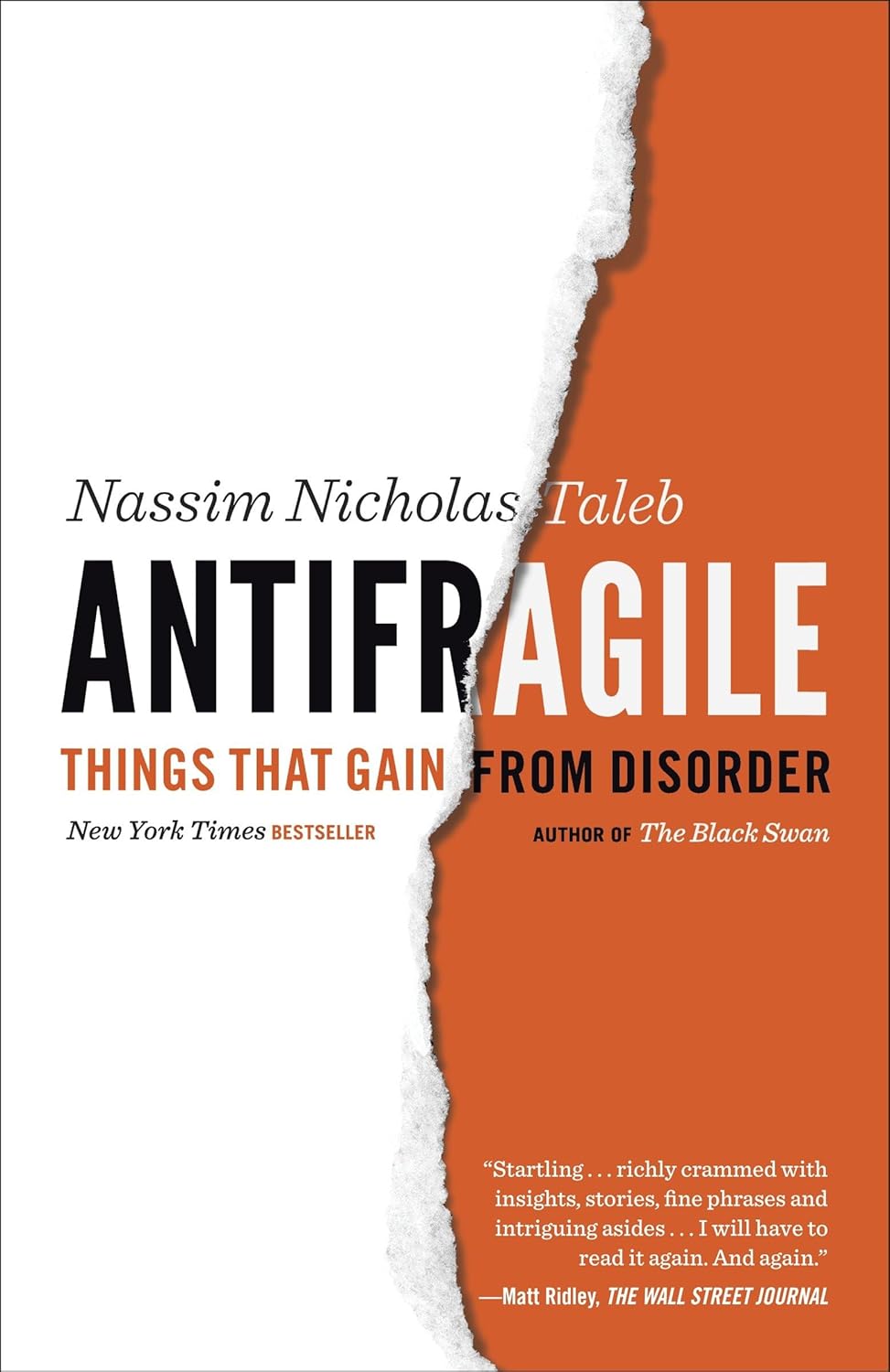
A trader loses his entire portfolio in 2008 following models that, according to his managers, had "never failed." A doctor prescribes a sedative to an anxious patient and triggers a dependency that wasn't there before. A government stabilizes wheat prices for twenty years, and when the drought finally hits, there's no adaptation mechanism left standing to respond. Nassim Nicholas Taleb didn't write a book about predicting disaster — he wrote about why the structures that look the most solid are usually the ones that survive a shock the worst.
The system starts from an uncomfortable technical observation: stripping volatility out of a system doesn't make it safer — it just shifts the risk somewhere else and makes it bigger. Taleb, an essayist and former financial risk trader, argues for measuring fragility instead of trying to predict disaster.
If you only remember one thing
It's far easier to tell whether something is fragile than to predict when it will break. That's why the right strategy isn't predicting the unpredictable — it's building structures that get better when it arrives.
- A system that never fails on a small scale is building up to a big one.
- Redundancy isn't inefficiency — it's the only reserve of capacity that works once efficiency stops working.
- You don't need to understand why something works in order to make use of it.
Audiovisual analysis
Audiovisual summary and podcast on the book’s central ideas.
Before we begin
The concepts you need to understand the system
The rest of this analysis takes seven ideas as already understood. Laying them out here means we won't have to define them again in every section.
Antifragility
What it means: the property of systems that don't just withstand shocks, but actually get better because of them.
Why it matters: it's the axis the whole system turns on; neither "fragile" nor "robust" describes something that grows stronger from disorder.
The Triad
What it means: a classification map that sorts any system as fragile, robust, or antifragile based on how it responds to disorder.
Why it matters: it lets you diagnose real exposure to risk before a shock ever reveals it.
Convexity (asymmetry)
What it means: a setup where the potential gains from volatility outweigh the potential losses.
Why it matters: it's the mathematical mechanism behind every antifragile gain.
The Barbell Strategy
What it means: pairing maximum protection at the base with a small exposure to unlimited upside, while avoiding the middle ground.
Why it matters: the middle ground offers no real protection — it's neither safe enough nor asymmetric enough.
Iatrogenics
What it means: the unintended harm caused by someone who intervenes in a complex system without understanding that volatility is necessary.
Why it matters: it explains why "helping" without judgment usually does more damage than the original problem.
Skin in the Game
What it means: the requirement to bear the negative consequences of your own decisions as a condition for having an opinion or making a call.
Why it matters: it filters out advice from people who offload their risk onto others without ever carrying it themselves.
The Lindy Effect
What it means: for anything non-perishable, every additional day it exists increases its future life expectancy.
Why it matters: whatever old thing has survived carries more real-world evidence built into it than any new theory does.
The shape of the book
Problem
Systems that look solid are quietly building up hidden fragility.
Common mistake
Believing that removing volatility makes something safer.
Thesis
Spotting fragility is easier than predicting the shock.
Framework
The Triad.
Application
Barbell, Via Negativa, Optionality, Skin in the Game.
Payoff
Turning error into cheap information.
01 — The central thesis
Why fragility is easier to spot than a shock is to predict
Modern intuition assumes that stripping volatility, risk, and uncertainty out of a system makes it safer and more predictable. Taleb shows the exact opposite is true: suppressing stressors doesn't neutralize risk, it just relocates it and amplifies it. Systems that never take small, frequent hits never learn how to recover — they quietly build up hidden fragility instead.
In practice, that means trying to predict the next Black Swan is almost always wasted effort. It's far more productive to redirect that effort toward a humbler but much more useful question: does this particular structure break under disorder, or does it actually benefit from it?
Central thesis
It's far easier to tell whether something is fragile than to predict when it will break — and that changes the entire strategy: instead of trying to predict the unpredictable, you need to build structures that get better when the unpredictable arrives.
Nearly every modern institution — corporations, financial systems, hospitals, governments — is designed around the paradigm of efficiency. Taleb's thesis implies that this design is fragile by structure, not by accident: whatever maximizes performance in calm conditions also maximizes the odds of collapse once the environment shifts.
02 — The central mechanism
How a system grows stronger from damage
Antifragility isn't magic or optimism — it's a concrete biological and structural mechanism, which Taleb explains through hormesis. Understanding that cycle is the foundation for designing any structure that benefits from disorder.
Step 1
Moderate stressor
Hormesis
A low dose of a stressor — exercise, fasting, controlled loss — challenges the system without destroying it.
Step 2
Partial damage
Survival threshold
The system takes real but recoverable wear, as long as the stressor stays below its survival threshold.
Step 3
Overcompensation
Surplus energy
The energy released in reacting to the setback generates more capacity than existed before the hit.
Step 4
Greater capacity
Antifragility
The system ends up better equipped to withstand the next stressor — stronger than it was before it took the hit.
The key difference lies in the nature of the system: a cat heals through stress, a washing machine just wears out. Applying washing-machine logic to a system that's actually a cat is the root error behind a large part of modern management.
03 — The system's components
The system's four pillars
Taleb organizes the practical application of antifragility into four operating pillars that work together.
01
The Triad
Classifies any component into one of three columns: fragile (hates disorder), robust (indifferent to it), or antifragile (benefits from it).
02
The Barbell Strategy
Pairs a base of maximum protection against ruin with a small exposure to risks carrying potentially unlimited upside. Rejects the middle ground entirely.
03
Optionality
A decision-making system built on rational trial and error: it acquires rights without obligations, keeps what works, and discards what doesn't, without ever needing to understand the root cause.
04
Via Negativa
Improvement through subtraction: remove whatever is generating fragility before adding any new component.
04 — The deep layer
The asymmetry everything else rests on
Underneath the four pillars sits a shared mathematical structure that explains why they work — and that's worth understanding so they don't get applied as a set of disconnected rules.
1
Convexity
If there's more to gain than to lose from volatility, the system is antifragile; if there's more to lose than to gain, it's fragile. This mathematical inequality is the framework's philosopher's stone: it turns uncertainty into a source of advantage rather than a threat.
2
Skin in the Game
No one should get to have an opinion or make a call without bearing the risk of personal loss. When that condition is missing, the risk doesn't vanish — it just gets transferred to whoever can't dodge it.
"Doxastic commitment, or soul in the game." — Nassim Nicholas Taleb
3
The Lindy Effect
For anything non-perishable, every additional day it exists increases its future life expectancy. Whatever old thing has survived carries more real-world information about the world than any recent theory, however appealing that theory sounds.
All three ideas share the same conceptual twist: antifragility doesn't depend on understanding why something works, but on structuring your exposure so that not knowing why isn't catastrophic.
05 — Points of friction
The errors that come from wanting to intervene
The system has predictable points of failure, almost all of them tied to the temptation to intervene without understanding the real complexity of the system.
Iatrogenics
The unintended harm caused by someone who intervenes in a complex system without understanding that volatility is necessary; it stems from the bias toward wanting to do something, whether or not it's the right move.
The Soviet-Harvard illusion
The mistaken belief that theoretical, academic knowledge is the sole engine of development, ignoring that practice usually comes before theory.
Neomania
The bias that undervalues the old and assumes the new is inherently superior, completely ignoring the Lindy Effect.
The agency problem
The systemic risk in which whoever makes the decision captures the benefit but offloads the negative consequences onto someone else.
The book itself acknowledges a structural limit: antifragility collapses if stressors exceed the system's survival threshold. Terminal stress doesn't strengthen — it destroys.
06 — Implementation protocol
How to put the system into action
Applying the system doesn't require predicting anything. It requires three simultaneous moves, repeated across every relevant area of your life or an organization.
01
Map the Triad
For each relevant area — finances, health, career, relationships — identify which elements are fragile, which are robust, and which are already antifragile.
02
Apply the Barbell
Ruthlessly protect the non-negotiable base — no debt that could turn terminal, no concentration that can't be absorbed — and deliberately expose the rest to low-cost, open-ended asymmetric bets.
03
Practice Via Negativa
Before adding any new element, identify and remove whatever is currently generating fragility.
04
Preserve optionality
Rather than locking yourself into a rigid plan, hold onto the ability to change course whenever new information justifies it.
05
Filter through Skin in the Game
Before following any piece of advice or intervention, check whether the person proposing it also bears the consequences if it goes wrong.
What to remember
- It's far easier to tell whether something is fragile than to predict when it will break.
- A system that never fails on a small scale is building up to a big one.
- Redundancy isn't inefficiency — it's the only reserve of capacity that works once efficiency stops working.
- Whoever doesn't bear the negative consequences of their own decisions is unknowingly offloading their fragility onto someone else.
- You don't need to understand why something works in order to make use of it.
What this book doesn't say
It's easy to read Antifragile as a personal resilience manual or a guide to stress management, but the book isn't about withstanding hits better — it's about redesigning structures so that hits make them better. Nor does it reduce to Stoic philosophy or positive thinking in the face of adversity: the framework is technical, quantitative, and structural, not attitudinal. And the Barbell isn't generic financial advice — it's a design principle applicable to any system with asymmetric exposure. The system doesn't guarantee outcomes either: antifragility doesn't promise success; it aims to limit the odds of a terminal error and to create the conditions for learning to accumulate.
Synthesis
Untested stability isn't the same thing as strength
Antifragile isn't about predicting chaos — it's about building structures that need chaos in order to work better. Stability that has never been put to the test isn't strength: it's fragility that hasn't found its shock yet.
That demands a shift in instinct that doesn't come naturally: no longer protecting every part of a system as if it were equally valuable, and accepting that the fragility and death of some parts is exactly what sustains the strength of the whole.
If a system's antifragility depends on the fragility of its parts — if the ecosystem improves because individuals die, if the economy learns because companies go bankrupt — at what point does the cost of the sacrificed parts stop being justified by the strength of the whole?