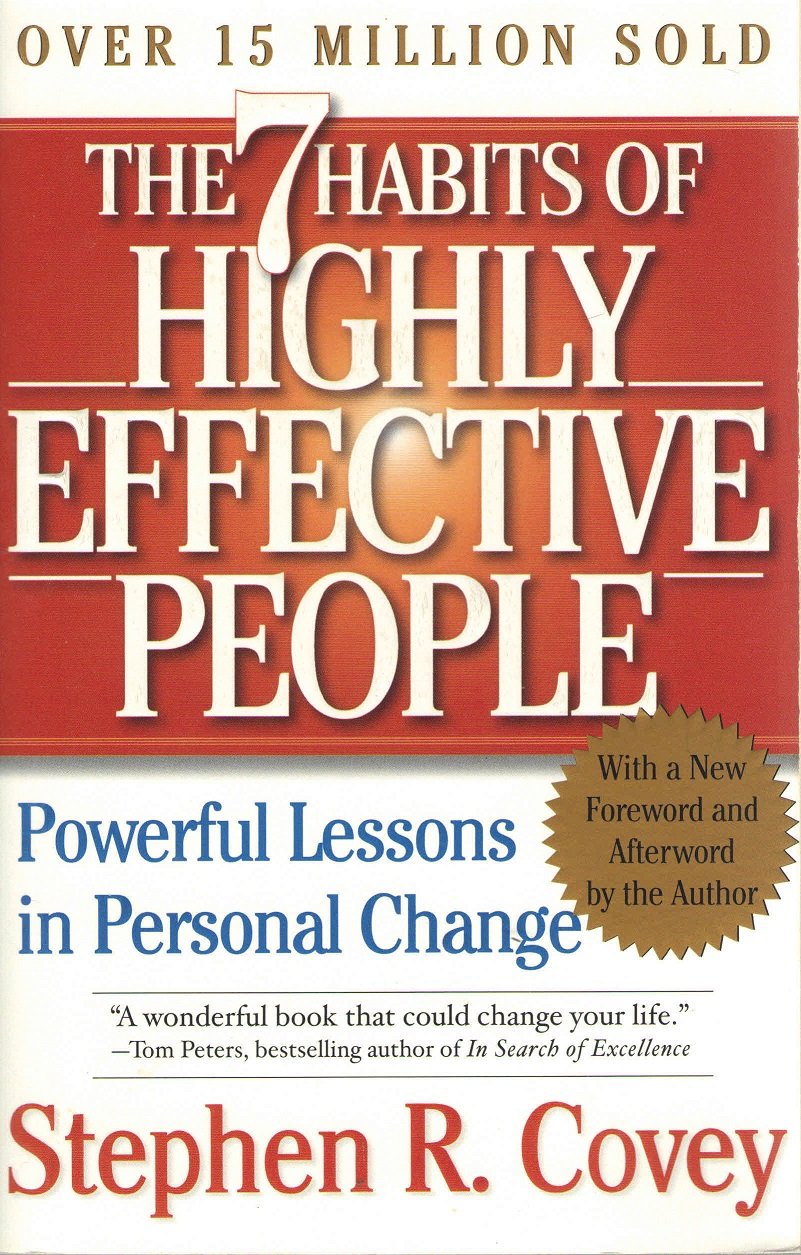
When a relationship grows strained or a team stops responding, the usual move is to reach for a technique: a better way to talk, to persuade, to come across as confident. It often works for a few days, and then the problem returns. Stephen R. Covey argues that this return is not bad luck but a sign that only the symptom is being treated. He proposes looking inward first, at how we see things and at our character, to understand why some results last and others don't.
The book starts from a distinction. On one side is the Character Ethic, grounded in integrity, patience and principles. On the other is the Personality Ethic, built on image and techniques of influence. On that foundation, Covey arranges seven habits into a sequence of personal growth. For Eudaimanya, its value lies in offering a way to tell changes that ease a problem from changes that actually solve it.
If you remember one idea
For Covey, lasting effectiveness does not come from techniques for making a good impression. It comes from first changing the way we see and the character we act from.
- Techniques of image and influence relieve symptoms, but they cannot fix problems rooted in character.
- The seven habits follow an order: personal independence first, then cooperation with others, and a final habit of renewal.
- The book defines effectiveness as getting results without destroying what produces them, starting with trust.
Audiovisual analysis
Audiovisual summary and podcast on the book’s central ideas.
Before you begin
Seven ideas for reading Covey
This analysis rests on seven concepts from the book. They are worth keeping in mind before moving on, because each section builds on them.
Inside-out
What it means: real change begins with how we see things and with our own character, rather than with circumstances or other people.
Why it matters: it is the thesis that organizes the whole book. Covey sets it against the outside-in approach, which waits for solutions to come from external factors.
Paradigm
What it means: the mental map through which each of us perceives and interprets what happens. As Covey puts it, we see the world not as it is, but as we are.
Why it matters: if the map is wrong, correcting behavior is not enough. The way we look has to be examined first.
Character Ethic and Personality Ethic
What it means: two ways of understanding success. The first rests on integrity, humility, patience and principles. The second rests on image, influence techniques and forced optimism.
Why it matters: Covey blames the failure of many solutions on the shift from the first to the second: the facade gets attention while the foundations are neglected.
Proactivity
What it means: the ability to choose our response to what happens, instead of reacting on impulse or under outside pressure.
Why it matters: it is the first habit and the book's central mechanism. Without it, a person is at the mercy of circumstances.
Maturity Continuum
What it means: the path of personal growth that Covey describes in three stages: dependence, independence and interdependence.
Why it matters: it explains the order of the seven habits. Personal autonomy comes first; cooperation with others comes after.
P/PC Balance
What it means: the balance between producing results (P) and caring for the capacity to produce them (PC), as in the fable of the goose that laid the golden eggs.
Why it matters: it is the book's definition of effectiveness. In relationships, that capacity is trust.
Habit
What it means: in the book, the point where three things meet: knowing what to do and why, knowing how to do it, and wanting to do it.
Why it matters: it explains why habits are hard to change. Information alone is not enough; skill and will are needed too.
The book in six steps
Problem
Image-based fixes for deep-rooted problems
Common mistake
Believing technique can stand in for character
Thesis
Change works from the inside out
Framework
Seven habits along the Maturity Continuum
Application
Examine the paradigm, choose the response, protect trust
Outcome
Results that don't exhaust their source
01 — Central thesis
Inside-out: character before technique
Faced with a conflict with a child, a colleague or a partner, most people look for a better way to say things, to persuade, or to project confidence. It is a reasonable response, and sometimes it works for a while. Covey, however, sees it as the root of many failures: using surface techniques on problems that run deeper.
The book frames this mistake as a shift. The Character Ethic emphasized integrity, humility, patience and courage. Against it, the Personality Ethic has gained ground: public image, communication techniques and a positive attitude cut off from reality. Covey calls these fixes “social aspirin,” because they ease the symptom while leaving the chronic problem untouched.
Covey's break with this approach lies in where he looks for the cause. If a problem is read through a faulty map, no adjustment in behavior will solve it. A paradigm, in this sense, is that map: the lens through which we interpret what happens. Hence one of the book's central ideas: the way we see the problem is the problem.
Central thesis
Covey argues that lasting change works from the inside out: first our way of seeing and our character change, and only then, in any stable way, our results and relationships.
Covey illustrates the weight of paradigms with two examples. The first is an ambiguous drawing in which some people see a young woman and others an old one, depending on what they were shown beforehand. The second is a scene on the New York subway. A man lets his children run wild without stepping in, and Covey's irritation vanishes when he learns that their mother has just died. No effort of will was needed: the interpretation changed, and the behavior changed with it.
The contrast between the two approaches the book sets against each other can be summed up like this:
The practical consequence is uncomfortable but clear. Before looking for a better technique, it pays to ask how the situation is being interpreted, and which part of the problem is ours to deal with.
02 — Core mechanism
Proactivity: the space between stimulus and response
Almost everyone knows what it is like to react badly to something that has just happened: a hurtful remark, a delay, a criticism. The usual explanation is that the situation caused the reaction, as if nothing stood between what happens to us and what we do.
Covey argues the opposite, drawing on an idea from Viktor Frankl: between stimulus and response there is a space, and in that space lies our freedom to choose. Proactivity, in this sense, is the ability to use that space to respond according to values rather than impulses. It is not simply taking the initiative, nor is it positive thinking. It means taking responsibility for our own response.
According to Covey, that space is not empty. It is sustained by four capacities he regards as uniquely human:
01
Self-awareness
Observing our own thoughts and moods as something separate from ourselves. It lets us notice an impulse without automatically obeying it.
02
Imagination
Envisioning possibilities beyond what we perceive in the moment. It lets us conceive of a response different from the usual one.
03
Conscience
An inner sense of principles and of what is fair, in Covey's terms. It serves as a standard for judging whether a response is right.
04
Independent will
Acting on that conscience without giving in to outside pressure or conditioning. It is the capacity that turns a decision into behavior.
The upshot is a shift in responsibility. If the response is chosen, the useful question is no longer “What have they done to me?” but “What do I do with it?” That is why proactivity comes first in the sequence of habits.
03 — Components of the system
The seven habits along the Maturity Continuum
A quick reading of the seven habits suggests treating them as a list of independent tips to pick and choose from. Covey frames them differently: as stages in a process of growth that has its own order.
That process is the Maturity Continuum, which Covey describes in three stages. Each reflects a different way of relating to our own results and to other people.
1
Dependence
The person relies on external factors to get results and holds others responsible for what happens to them. This is where the journey starts.
2
Independence
The person takes responsibility for their own behavior and decisions, and becomes physically, mentally and emotionally self-reliant. Covey calls this achievement the Private Victory. It is built on three habits: Be Proactive, Begin with the End in Mind, and Put First Things First.
3
Interdependence
People who are already independent cooperate to achieve what none of them could manage alone. This is the Public Victory, and it rests on three habits: Think Win/Win, Seek First to Understand, Then to Be Understood, and Synergize.
The seventh habit, Sharpen the Saw, is not a stage of its own; it runs through all of them. Its role is the ongoing renewal of four dimensions of the person: physical, mental, spiritual and social.
The consequence is a warning about sequence. According to the book, the habits of cooperation cannot be genuinely practiced until independence has been established. Anyone who wants to become a better team player would, paradoxically, have to start with the habits that have nothing to do with the team.
04 — The deeper layer
The P/PC Balance: results without exhausting their source
Anyone who leads a team or raises a child knows the temptation to get the result now, even if it takes pressure. A raised voice gets instant obedience; an unexplained demand gets the day's task done.
The mistake, Covey argues, is to measure effectiveness only by output. To make the point he turns to the fable of the goose that laid the golden eggs: kill the goose to get more eggs, and you end up with none. Effectiveness, in this sense, is the balance between producing results (P) and caring for the capacity that produces them (PC).
The book applies this logic to three different areas:
01
Physical assets
Production is what a machine yields; capacity is its maintenance. Without maintenance, the machine eventually breaks down and production stops.
02
Money
Production is interest or income; capacity is the capital, or the ability to earn. Spending the capital wipes out future income.
03
Relationships
Production is cooperation and shared work; capacity is trust. Forcing the result, as when shouting at a child, wears away the trust on which future results depend.
In human relationships, Covey calls this capacity the Emotional Bank Account. The term refers to the trust built up in a relationship, including an understanding of how the other person sees things. The banking image underlines that trust can grow or run out.
Behind this balance lies an idea that runs through the whole book. Covey treats principles as natural laws: like a lighthouse, they govern the consequences of what we do, whatever we may think of them. Within this framework, the P/PC Balance is not a management preference but a description of how things work.
In practice, this changes the yardstick. A decision is judged not only by the result it produces today, but also by what it does to the trust, the capital or the condition of whatever will have to produce results tomorrow.
05 — Points of friction
Limits and conditions: why change is slow
Readers who discover the book often start out enthusiastic, only to find a few weeks later that they still react as they always did. The temptation is to conclude that the framework doesn't work, or that they lack willpower.
Covey anticipates this disappointment with what he calls the Law of the Harvest. The idea is that human development, like any natural process, cannot skip stages: there is no harvest without sowing. Anyone who tries to fake mastery of the piano, of tennis or of their own character without going through the learning gets nothing but ineffectiveness and frustration.
Four conditions emerge from the book that limit how it can be applied:
The pull of habit
Covey compares the force of ingrained habits to the gravity a rocket must overcome at liftoff. The greatest effort comes at the start of the change.
An order that can't be skipped
The cooperation the book describes requires independence first. Attempting the Public Victory without the Private one leaves the relationship with nothing to stand on.
The door of change
Covey borrows an idea from Marilyn Ferguson: the door of change can only be opened from the inside. Within this framework, change cannot be imposed on someone else; it depends on their own decision.
Technique without character
Using the habits of cooperation as techniques to get others to do what we want repeats the very mistake the book criticizes: the logic of the Personality Ethic.
The framework also has a defined scope. It focuses on what each person can do with their own character and their own response. Within this approach, what depends on others can only be addressed through influence and cooperation, and what cannot be changed calls for acceptance. The book does not promise control over circumstances, but a different way of standing in relation to them.
06 — Application
Putting the framework to work: four questions
Covey does not present his approach as a procedure you can apply in an afternoon. The seven habits describe slow growth, and the Law of the Harvest rules out shortcuts.
What can be done from the outset is to use the framework as a lens for reading a specific situation. The four questions below are Eudaimanya's editorial arrangement of the book's concepts. They follow its inside-out logic.
01
How am I seeing this situation?
Before looking for a solution, examine the paradigm. The subway scene shows that a different interpretation can change the response without any need to force it.
02
What part of this is up to me?
The aim is to separate three areas: what depends on our own behavior, what depends on others and can only be influenced, and what cannot be changed and must be accepted. This classification is editorial; its purpose is to focus energy where there is a real capacity to act.
03
Which response do I choose?
This is where the space between stimulus and response comes into play: notice the impulse, imagine alternatives, weigh them against your principles, and act accordingly. Each step corresponds to one of the four endowments Covey describes.
04
What does this decision do to trust?
Each decision is weighed by its immediate result and also by its effect on the capacity to produce future results. In a relationship, that capacity is the Emotional Bank Account.
These questions are no substitute for the habits, which take time. Their use is in spotting when social aspirin is being applied to a deep-rooted problem.
What to remember
- For Covey, image techniques relieve symptoms; deep-rooted problems call for work on character.
- The way we see a problem is part of the problem.
- Between what happens and what we do, there is a space in which the response is chosen.
- The habits have an order: independence first, cooperation second.
- In the book's sense, a result that destroys the trust that made it possible is not effective.
What the book doesn't say
It is easy to read The 7 Habits of Highly Effective People as a list of productivity tips or as an invitation to think positively. The book says almost the opposite: it criticizes a positive attitude cut off from reality, and it presents the habits as a sequence, not a menu to choose from.
Nor does it equate proactivity with taking the initiative or doing more. In Covey's account, being proactive means taking responsibility for one's own response. And the approach comes with an explicit condition: the change it describes is slow, and it can only begin with one's own decision.
Synthesis
Look before you act
The 7 Habits starts from a simple observation: many solutions fail because they work on the surface. Covey's answer is to turn attention inward, to the paradigm through which we interpret reality and the character from which we respond.
Seen this way, the book is less a manual for effectiveness than an argument about the order of things: first how we see, then how we act, then how we relate to others. Its demands are also its limit. It offers no shortcuts, and it makes change depend on a decision no one can make for someone else.
If our paradigms shape what we see, how can we tell that a map is wrong when it is the very one we are looking through?